
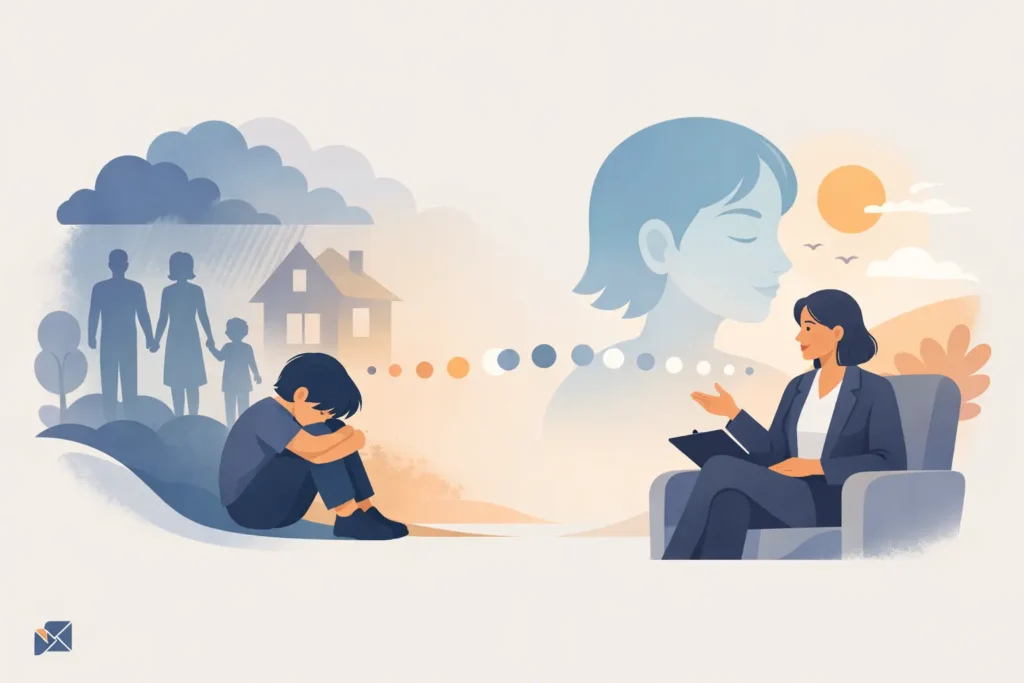
You can be a capable adult on the outside and still feel as if some part of you is stuck years behind. A tone of voice. A certain look. Being ignored. Being criticised. Suddenly your body reacts before your mind has caught up. If you are asking can EMDR help childhood trauma, the short answer is yes, it often can. But like most things that actually work, the real answer is a bit more specific than that.
Childhood trauma does not always look dramatic. Sometimes it comes from obvious events like abuse, neglect, violence or loss. Sometimes it comes from repeated experiences that taught your system you were not safe, not good enough, not wanted or always about to get hurt. That can shape anxiety, panic, people pleasing, anger, addiction, low confidence, relationship struggles and a constant feeling of being on edge.
The hard part is that many people know they are overreacting in the moment, but that knowledge does not switch it off. You can understand your pattern and still keep repeating it. That is usually the point where people realise they do not need more talking. They need something that helps the brain and body update what is still being treated as a live threat.
What EMDR actually does
EMDR stands for Eye Movement Desensitisation and Reprocessing. The name sounds technical, but the idea is simple. When something overwhelming happens, the brain does not always process it properly. Instead of becoming an old memory, it stays stuck in a raw, emotionally charged form. So years later, something small can trigger the same fear, shame or helplessness as if it is happening now.
EMDR helps the brain reprocess that memory so it no longer feels current. The event is not erased. You still know what happened. But it stops running the show in the same way.
That matters because a lot of adult problems are not really about the present moment. They are old survival responses still firing in the present. If a child had to stay hyper alert, shut down emotionally, keep the peace or expect rejection, that can become an automatic pattern in adult life.
Can EMDR help childhood trauma in every case?
It can help a great deal, but not every person needs the exact same route.
Some childhood trauma comes from one or two clear events. In those cases, EMDR can be very direct and very effective. Other people had years of instability, criticism, fear or emotional neglect. That creates a more layered pattern. EMDR can still be useful, but the work may need to be done in a more structured way, with the right preparation and pacing.
This is where experience matters. If someone has spent years living in survival mode, you do not just charge straight into painful memories and hope for the best. Good work is not about flooding people with emotion. It is about helping the system feel safe enough to update what is stuck.
For some people, EMDR is the main tool. For others, it works best as part of a wider approach that also deals with the beliefs, habits and emotional responses built on top of the trauma. That is often where lasting change happens.
Why childhood trauma keeps showing up in adult life
A lot of people minimise what happened to them because somebody else had it worse. That comparison keeps many people stuck.
Your nervous system does not work by comparing your story with someone else’s. It works by learning what to expect. If your early life taught you that love was unsafe, conflict was dangerous, calm never lasted or your needs did not matter, your system adapts around that. The adaptation may have helped you then. It just does not help you now.
That is why childhood trauma can show up as overthinking, poor sleep, health anxiety, fear of abandonment, emotional eating, drinking too much, gambling, procrastination or self sabotage. People often focus on the behaviour and miss the driver underneath it.
When the root is still active, coping strategies only go so far. You can manage symptoms for years without actually feeling free.
You do not always need to talk through everything
This is one of the biggest reasons people ask about EMDR in the first place. They want help, but they do not want to spend months going over painful memories in detail.
That is understandable. Many people avoid trauma work because they assume they will have to relive every moment. In reality, effective trauma work does not have to mean telling the whole story from beginning to end.
EMDR can often help process what is stuck without turning sessions into repeated retellings of the past. For many clients, that feels safer and more practical. They want relief, not endless analysis.
That does not mean the work is emotion free. Real change usually involves some level of discomfort because you are updating something that has been frozen for years. But there is a big difference between processing a memory properly and being trapped in it.
What changes when EMDR works
When EMDR helps childhood trauma, the biggest shift is usually this: the past stops feeling like it is still happening.
Triggers often lose their charge. Situations that used to spark panic, shame or anger start to feel more manageable. People often notice they can think more clearly, sleep better, set better boundaries and stop taking everything so personally.
Some describe it as feeling lighter. Others say it is like finally having space in their own head. The event is still part of their history, but it no longer controls their reactions in the same way.
That can have a knock on effect across the whole of life. Relationships improve because you are not reacting from old fear. Confidence improves because you are not carrying the same old identity. Addictive or compulsive patterns can ease because the emotional driver underneath them has started to shift.
When EMDR on its own may not be enough
This is where honesty matters.
If someone has deep trauma and a life built around avoiding feelings, keeping control or numbing out, there may be more to work on than the memory itself. You may also need to change the patterns built around it. That could include the way you think, what you expect from other people, how you respond to stress and the habits you use to cope.
That is not bad news. It just means change is not always about one technique. The best results often come from using the right method at the right time, in the right order.
If a person is highly dissociated, actively addicted, in constant crisis or lacking any sense of safety in daily life, the first step might be stabilising things before going deeper. Rushing that process does not make you brave. It usually just makes the work harder.
What to look for if you are considering EMDR
If you are thinking about this seriously, focus less on the label and more on the result you want. You want someone who understands trauma properly, knows how to pace the work and is interested in helping you change the pattern, not just talk about it.
You should feel safe, but not babied. Supported, but also guided. Good trauma work is compassionate and direct. It should help you make sense of what is happening without making you feel broken.
It also helps to work with someone who understands that not everybody wants long term therapy. Many people are exhausted by years of coping and want a practical route forward. That does not mean cutting corners. It means working with focus and purpose.
Can EMDR help childhood trauma if you have tried therapy before?
Yes, and this is often where it makes the biggest difference.
A lot of people have already tried counselling, CBT or medication. Some found it useful. Some did not. Some understood themselves better but still felt the same underneath. That can be frustrating, especially when you have put time and effort into trying to change.
The reason EMDR can help where other approaches have not is that it does not rely on talking yourself out of a response that is coming from a deeper level. If the body still reads something as danger, logic alone will not settle it.
That is why people sometimes say, I know why I do this, but I still do it. Insight is helpful. But insight without change can feel like being stuck with a really good explanation.
If you have been living with the effects of childhood trauma for years, there is no prize for carrying it forever. The fact that a pattern has been there a long time does not mean it is permanent. Old responses can change when the brain and body are given the chance to process them properly.
And that is the real reframe here. Childhood trauma is not proof that you are damaged for life. It is often proof that your system adapted well to a bad situation and never got the update that the danger has passed.
If that lands, then the question is no longer just can EMDR help childhood trauma. The better question is whether you are ready to stop managing an old pattern and start changing it.
Ready to experience real change or keep repeating the same pattern? Book your Real Change Meeting here https://Derekmindcoach.as.me/