
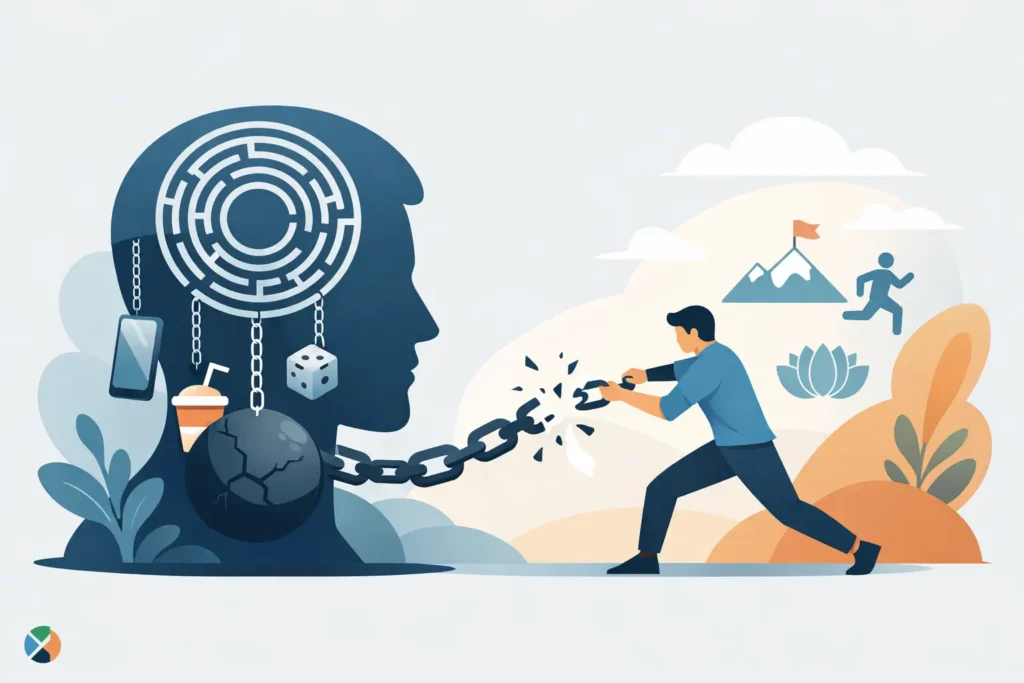
You tell yourself this is the last time. Then it happens again. The late night binge, the panic driven checking, the gambling slip, the cigarette you were done with, the pull towards the same toxic pattern. If you are here looking for a guide to breaking compulsive habits, you probably do not need more advice about willpower. You need to understand why the habit keeps beating your best intentions.
That matters, because compulsive habits are rarely about weakness. Most people I speak to are not lazy, careless or lacking discipline. They are exhausted. They have spent months or years trying to stop something that makes no sense to them anymore. They know the cost. They can see the damage to their health, confidence, work and family life. Yet part of them still keeps reaching for the same thing.
Why compulsive habits are so hard to stop
A compulsive habit is not just a bad choice repeated often. It is usually a learned response that has become automatic. At some point, your mind linked a behaviour with relief, escape, control or comfort. That link may have started years ago. It may have come from anxiety, stress, trauma, boredom, loneliness, pressure or emotional overwhelm.
The problem is that the mind does not always update on its own. So even when the behaviour is now harming you, the deeper part of the mind may still treat it as useful. It still sees it as the answer to a feeling you do not want, even if the answer is ruining your life.
That is why logic alone often fails. You can know smoking is damaging you. You can know the constant checking is keeping anxiety alive. You can know the drinking, scrolling, skin picking or compulsive eating is making things worse. But if the behaviour is wired to relief, the urge can override the promise you made five minutes earlier.
This is also why shame makes it worse. When people feel disgusted with themselves, they often become more anxious, more isolated and more desperate for relief. Then the same habit steps back in as the familiar escape route.
A guide to breaking compulsive habits starts with the right question
Most people ask, how do I stop doing this?
That sounds sensible, but it is often the wrong starting point. A better question is, what is this habit doing for me right now?
That does not mean the habit is good for you. It means there is usually a payoff, even if it is only temporary. It may calm your nerves for ten minutes. It may numb difficult feelings. It may give you a sense of certainty. It may distract you from memories, pressure or self criticism.
Until you identify that payoff, you will keep trying to rip out a behaviour without replacing the job it is doing.
This is where people get stuck in a cycle of stop, relapse, beat themselves up, try again. They treat the habit as the whole problem, when the habit is often the mind’s poor solution to something deeper.
The real reason willpower keeps letting you down
Willpower has a place, but it is unreliable when a pattern has become automatic. If you are stressed, tired, triggered or overwhelmed, your mind will fall back on what feels familiar. That is not a character flaw. It is how conditioning works.
The more emotional the trigger, the less useful lectures from yourself become. In the moment, your system is not looking for a motivational speech. It is looking for safety, relief or release.
This is why people can be strong in every other area of life and still feel powerless around one specific habit. They may be high functioning, caring, capable and responsible. Then one trigger hits and the pattern is off again. That contrast can make people feel even more broken. They are not broken. They are running a programme that needs updating.
Reframing the problem changes everything
If you see yourself as weak, you will keep fighting yourself.
If you see the habit as a conditioned response, you can start changing it properly.
That shift matters. It moves you away from blame and towards action. Instead of asking why am I like this, you start asking what is driving this and how do I change it at the right level?
For some people, the driver is anxiety. For others, it is unresolved trauma, fear of failure, fear of rejection, stress, anger or emotional shutdown. Sometimes the habit started as protection. Sometimes it was copied from people around you. Sometimes it grew quietly until it became part of daily life.
It depends on the person. Two people can have the same habit for completely different reasons. That is why generic advice often falls flat. If you treat every compulsive pattern the same, you miss what is actually keeping it in place.
How to break compulsive habits in a way that lasts
Real change tends to happen when you work on both the trigger and the response.
First, you need to spot the pattern clearly. Not vaguely. Clearly. What happens just before the urge? Is it a feeling, a thought, a memory, a place, a time of day, a certain person, or that hollow sense that you need something now? The more specific you get, the less mysterious the habit becomes.
Second, you need to reduce the emotional charge behind the trigger. If your system reacts as though stress, boredom or discomfort is unbearable, you will keep reaching for the familiar fix. This is where deeper change work can make a huge difference. You do not always need years of talking to change an old response. When the unconscious pattern shifts, the urge often loses strength far faster than people expect.
Third, you need a replacement that actually works. Telling yourself to simply stop is rarely enough. If the habit has been giving you relief, you need another way to create calm, certainty or control that does not cost you afterwards. That replacement has to be practical. It has to fit real life. If it feels fake or forced, you will not use it when you need it most.
Fourth, you need to stop identifying with the habit. This is a big one. When people keep saying I am a compulsive person, I always mess things up, or this is just how I cope, they keep the pattern tied to their identity. The habit may be familiar, but it is not who you are. It is something your mind learned. Learned patterns can be changed.
What a practical guide to breaking compulsive habits should tell you
You may need support, especially if the pattern is tied to trauma, addiction, panic or long standing anxiety. That is not failure. It is common sense.
Trying to force change on your own can work for simple habits, especially if the trigger is obvious and the emotional pull is light. But when a pattern feels bigger than you, support can speed things up massively. The right help should not keep you analysing the same story forever. It should help you update the driver behind the behaviour so you can feel the difference in daily life.
That is what many people miss. They focus only on controlling the behaviour. They count days, avoid triggers and hope the urge fades. Sometimes that helps. Sometimes it does not. If the root stays active, you can end up white knuckling your way through each week.
A better route is to change the internal response so you are not fighting as hard in the first place.
What progress really looks like
Progress does not always mean never thinking about the habit again from day one. Sometimes it starts with space. The urge comes up, but it no longer owns you. The trigger is there, but it does not hit as hard. You notice choice returning.
That space is powerful. It is where control comes back.
From there, confidence builds quickly. You stop fearing every evening, every quiet moment, every stressful day. You trust yourself more. You feel less trapped. And when your mind no longer sees the habit as the answer, the whole pattern starts to weaken.
People often think they need more discipline. In many cases, they need less inner conflict and a better method.
If you have been stuck in the same cycle for a long time, do not use that as proof you cannot change. Use it as proof that the approach needs to change. There is a difference.
You are not meant to spend years managing the same problem and calling that normal. If a compulsive habit is running part of your life, affecting your peace, your relationships or your self respect, then it is worth dealing with properly. Real change can happen much faster when you work with the part of the mind that is actually driving the pattern.
Ready to experience real change or keep repeating the same pattern? Book your Real Change Meeting here https://Derekmindcoach.as.me/