
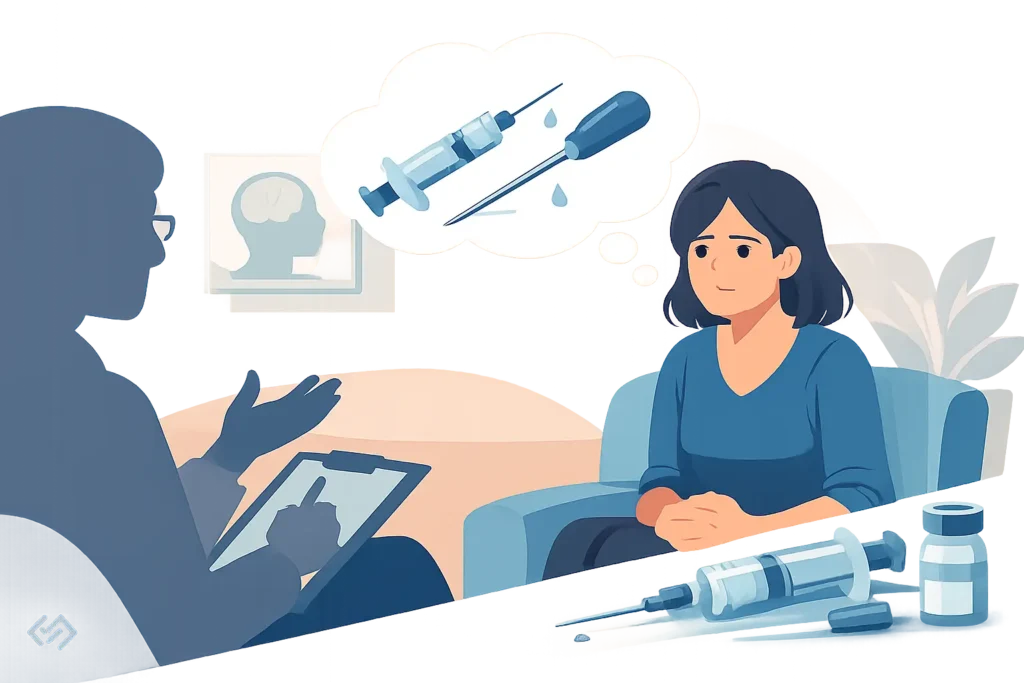
That moment before an injection can feel worse than the injection itself. Your heart races, your stomach turns, your body tenses, and suddenly a simple blood test or vaccine feels impossible. If you are searching for the best therapy for fear of needles, you probably do not want a long explanation. You want to know what actually works.
The short answer is this. The best approach is usually the one that changes the fear response at the level where it is being triggered, not the one that just teaches you to put up with it. For some people that means exposure based work. For others, especially when the reaction feels automatic, intense or linked to earlier experiences, approaches such as hypnotherapy, EMDR and other unconscious change methods can be far more effective.
Why needle fear feels so powerful
A fear of needles is not weakness. It is a learned response. Your mind and body have linked needles with danger, pain, loss of control or panic. Once that pattern is in place, the reaction can fire before you have had time to think.
That is why so many people say, “I know it is irrational, but I still cannot do it.” Logic is not the problem. The problem is that the emotional response is stronger than the logical one in the moment.
For some, the fear started after a bad experience as a child. For others, it built up over time after several stressful medical appointments. Sometimes it is less about the needle itself and more about feeling trapped, watched or not in control. Some people are frightened of pain. Others faint at the sight of blood or the thought of something going into the skin.
This matters because the best therapy for fear of needles depends on what is driving the fear. If the pattern is mild, practical coping methods may help. If the reaction is deep, automatic and disruptive, you need something more targeted.
What most people try first and why it often falls short
Most people start by forcing themselves through it. They grip the chair, look away, hold someone’s hand and hope for the best. Sometimes they get through it. Sometimes they cancel the appointment, avoid booking the next one or spend days feeling sick with dread beforehand.
The problem with white knuckling your way through is that it rarely changes the pattern. You might survive the appointment, but your system still treats needles as a threat. In some cases, each stressful experience actually strengthens the fear.
Breathing exercises, distraction and reassurance can help take the edge off. There is nothing wrong with them. But if you have already tried those things and still panic, they are probably not enough on their own.
Best therapy for fear of needles – what actually works?
If you want a straight answer, the best therapy for fear of needles is the one that helps your brain stop treating needles like danger. That can happen in different ways.
Traditional talking therapy can be useful if you need to understand how the fear developed, but insight alone does not always change a phobic response. You can understand your fear perfectly and still freeze in the treatment room.
CBT can help some people by challenging catastrophic thinking and gradually reducing avoidance. That is often useful when the fear is fuelled by thoughts such as “I will not cope” or “something terrible will happen”. But CBT is not always enough when the body reaction is immediate and overwhelming.
Exposure therapy is one of the most commonly recommended treatments for phobias. Done well, it can work. The idea is simple. You gradually face the fear in controlled steps until the brain learns that the situation is safe. The trade off is that some people find it slow, stressful or hard to stick with, especially if the fear is severe.
This is where more direct change methods can make a real difference. Hypnotherapy, EMDR, MEMI and other focused approaches work on the emotional pattern itself. Instead of spending weeks trying to manage the fear, the aim is to change how the mind is coding the experience. When that happens, the trigger loses its charge.
That is often why people who have struggled for years can suddenly find the fear is no longer running the show. They still know what a needle is. They just do not react to it in the same way.
Why unconscious change methods can be so effective
A needle phobia is rarely just a bad habit. It is usually an automatic protection response. That means the part of you reacting is not the calm, sensible part. It is the part that thinks it is keeping you safe.
Trying to reason with that part in the moment is often frustrating. You tell yourself to calm down, but your body does the opposite. That is why approaches that work at the unconscious level can be so powerful. They are aimed at the source of the reaction, not just the symptoms.
In practical terms, that may involve updating how the brain stores a past event, reducing the emotional intensity attached to the trigger, and helping your system learn a new response. You do not always need to keep revisiting the past in detail to make that happen.
For many people, this feels like a relief. They are not looking for years of analysis. They want the panic to stop. They want to sit in the chair without feeling like they are under attack.
It depends on your type of needle fear
Not all needle fears are the same, and this is where a lot of generic advice misses the mark.
If your fear is mostly anticipatory, meaning you spend days worrying beforehand, then the work may need to focus on anxiety, imagined outcomes and mental rehearsal. If your fear comes from a specific bad experience, then clearing the emotional impact of that event is often key. If you faint, feel dizzy or go weak, there may be a strong physical response pattern that needs a slightly different approach.
If your child is struggling, the same principle applies. Telling them “it is nothing” usually does not help because to them it does not feel like nothing. The fear is real in their system, even if the danger is not.
That is why there is no single script that works for everyone. The best therapy for fear of needles is the one that matches the reason your mind learned the fear in the first place.
What real change looks like
Real change does not mean pretending to love injections. It means the fear stops controlling your choices.
You can book a blood test without the build up of dread. You can take your child to an appointment without your own anxiety spilling over. You can deal with dental work, vaccinations, hospital treatment or routine health checks without feeling trapped.
Sometimes the shift is dramatic. People who used to avoid appointments altogether are able to sit calmly and get it done. Sometimes it is more gradual but still life changing. The panic drops, the body settles, and there is finally a sense of control.
That matters more than labels. You do not need to become fearless. You just need the reaction to stop hijacking you.
If you have tried before and it did not work
A lot of people assume they are the problem because they have already tried therapy, relaxation apps or sheer determination and still struggle. Usually, the issue is not that you cannot change. It is that the approach did not fit the pattern.
If you have spent years managing the fear rather than resolving it, it can start to feel permanent. It is not. Old patterns can shift quickly when you target the right thing.
That is one reason a direct, structured approach can be so helpful. Instead of circling the issue, you work on what is actually driving it. For some, that means one clear memory. For others, it means a build up of stress, helplessness or previous panic. Either way, the goal is the same. Stop the old response and install a better one.
Derek Chapman works with fears, phobias and anxiety in a way that is practical and results focused, helping people change patterns properly rather than just cope with them.
So what is the best next step?
If your fear of needles is affecting your health, delaying treatment or causing distress every time an appointment comes round, do not keep brushing it off as one of those things. It is treatable.
The best therapy for fear of needles is not always the most talked about one. It is the one that helps your mind and body stop reacting as if a routine procedure is a threat. For many people, that means going beyond coping strategies and working with methods that create change at the level where the fear lives.
You do not have to keep dreading appointments. You do not have to keep forcing yourself through it and hoping next time will be different. With the right help, it can be different.
Ready to experience real change or keep repeating the same pattern? Book your Real Change Meeting here https://Derekmindcoach.as.me/