
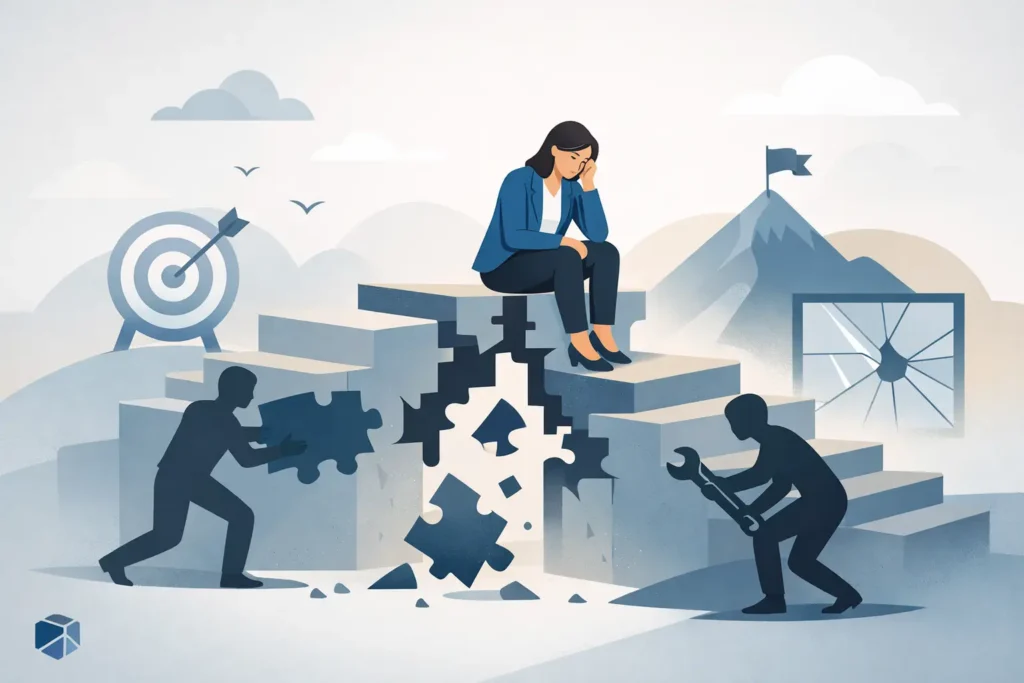
You tell yourself this time will be different. You will stop overthinking, stop pushing people away, stop reaching for the thing that ruins your progress, stop talking yourself out of opportunities you actually want. Then it happens again, and you are left asking, why do I keep self sabotaging?
That question usually comes with frustration, shame and a bit of confusion. Because on the surface it makes no sense. Why would anyone get in their own way? Why would you ruin something you care about, repeat a habit that makes life harder, or back away from the very thing that could help?
The short answer is this. Self sabotage is rarely random, and it is not proof that you are weak, lazy or broken. It is usually a pattern your mind has learned for a reason. The problem is that the reason may have made sense once, but it does not help you now.
Why do I keep self sabotaging when I want better?
Because wanting better and feeling safe with better are not always the same thing.
That is the part many people miss. Consciously, you may want calm, confidence, healthy relationships, better sleep, freedom from addiction, or a proper chance at success. But if part of your mind links those things with risk, pressure, disappointment, rejection or loss of control, it will pull you back towards what feels familiar.
Familiar is powerful, even when it is painful. A person can be deeply unhappy in a pattern and still keep repeating it because the pattern is known. The mind often chooses certainty over possibility. It does not always choose what is best. It chooses what feels safest.
That is why self sabotage can look so irrational from the outside. You might put things off until the last minute, pick arguments when things are going well, drink when you promised yourself you would not, avoid calls, cancel plans, binge, spend, shut down or talk yourself out of trying. Different behaviours, same underlying problem. Something in you is trying to prevent discomfort, exposure or change.
What self sabotage really looks like
It is not always dramatic. Sometimes it is obvious, like relapsing into an old addiction, blowing up a relationship, or quitting the moment progress starts. But often it is quieter than that.
It can look like perfectionism, where nothing is ever ready so nothing gets finished. It can look like overthinking, where every decision gets delayed until the opportunity passes. It can look like people pleasing, where you abandon your own needs and then resent everyone around you. It can look like low confidence, but under that there is often a deeper belief that says, do not stand out, do not risk failure, do not expect too much.
Some people sabotage by staying busy. Others sabotage by switching off. Some numb themselves. Some create chaos. Some keep choosing the same type of partner, the same kind of stress, the same story about themselves, then wonder why life never really changes.
If this is you, it does not mean you want a bad life. It means the pattern is stronger than your willpower alone.
Why it happens in the first place
Most self sabotage starts as protection.
If you grew up around criticism, conflict, unpredictability or emotional pain, your mind may have learned to stay small, stay guarded or stay in control. If you experienced trauma, rejection or repeated disappointment, part of you may expect good things to be taken away. If you were made to feel not good enough, success can bring exposure rather than relief.
So the mind adapts. It creates habits, reactions and coping behaviours that reduce the immediate threat. The trouble is those same responses can keep running long after the original situation has gone.
That is why insight alone often does not fix it. You can know exactly what you are doing and still do it. You can read the books, repeat the affirmations, make the promises and understand your triggers, then find yourself back in the same place. That is not because change is impossible. It is because the pattern is being driven from deeper than logic.
When the unconscious mind believes something is protecting you, it will keep doing it until that belief changes.
The hidden beliefs behind self sabotage
People rarely sabotage for no reason. There is usually a belief underneath it, even if you would never say it out loud.
It might be, if I fail, I will be judged. If I succeed, people will expect more from me. If I get close to someone, I will get hurt. If I relax, I will lose control. If I stop this habit, I will not know how to cope. If I become confident, people will think I have changed. If I really try and it still does not work, that will hurt more than not trying at all.
These beliefs are not always conscious. They can sit in the background quietly driving behaviour for years. That is why self sabotage can feel automatic. It is often not a decision in the moment. It is a conditioned response.
This matters because you do not solve a conditioned response by blaming yourself. You solve it by changing the response.
Stop calling it laziness
A lot of people are too hard on themselves. They call themselves weak, stupid, lazy, hopeless, addictive, damaged or beyond help. That sort of self talk only strengthens the cycle.
If you are attacking yourself every time the pattern shows up, you add shame to the problem. Shame makes people hide, avoid and numb out. It does not create lasting change. It creates more pressure, and pressure often drives the very behaviour you are trying to stop.
That does not mean giving yourself a free pass. It means being accurate. Self sabotage is a learned pattern. Learned patterns can be changed.
There is a difference between excusing the behaviour and understanding it properly. The second one is where change starts.
How to stop self sabotaging properly
You do not need more promises to yourself. You need to break the pattern at the level it is running from.
That starts with identifying what the behaviour is doing for you. Not what it costs you, you already know that. What does it give you in the moment? Relief? Escape? Distance? Numbness? Control? Protection from disappointment? Once that becomes clear, the pattern makes more sense.
Then you need to deal with the real driver, not just the symptom. If someone drinks to switch off anxiety, simply trying to remove the drink without changing the anxiety response can feel like white knuckling it. If someone avoids relationships to prevent rejection, telling them to be more open misses the point. If a person keeps procrastinating because success feels exposing, productivity tips will only go so far.
This is where practical change matters. When the unconscious threat response shifts, behaviour becomes easier to change. You are not fighting yourself all day. You are not relying on motivation every five minutes. The thing that used to pull you off course simply loses strength.
That is why structured work can help where endless analysing has not. You do not always need years of talking about the past to change what is happening now. In many cases, once the mind no longer sees the old pattern as necessary, the behaviour starts to move quickly.
Why willpower is not enough
Willpower has its place, but it is not reliable when a pattern is wired into emotion, habit and self protection.
At your best, willpower can help you interrupt a behaviour. At your worst, when you are tired, stressed, triggered or overwhelmed, it usually folds. That is why people can be doing fine for days or weeks and then suddenly slip back into old reactions. Nothing has gone wrong with their character. The deeper pattern has been activated.
Real change is not about becoming more strict with yourself. It is about removing the need for the sabotage in the first place.
That might mean updating old trauma without having to talk through every detail. It might mean changing how your mind responds to fear, rejection or pressure. It might mean clearing the emotional charge that keeps the habit alive. Whatever the route, the goal is the same. Less inner conflict, more control.
A better way to look at yourself
If you keep repeating the same destructive pattern, the answer is not to think less of yourself. It is to get curious about what your mind has been trying to do for you, even badly.
Because once you understand that self sabotage is protection gone wrong, something shifts. You stop seeing yourself as the problem. You start seeing the pattern as the problem. And patterns can be changed.
That is when people begin to feel hope again. Not the vague kind built on wishful thinking, but the solid kind that comes from finally understanding why this keeps happening and knowing it does not have to keep happening.
You can stop living in reaction mode. You can stop repeating the same cycle. You can feel more like yourself again, not by managing the problem forever, but by changing what is driving it.
Ready to experience real change or keep repeating the same pattern? Book your Real Change Meeting here https://Derekmindcoach.as.me/