
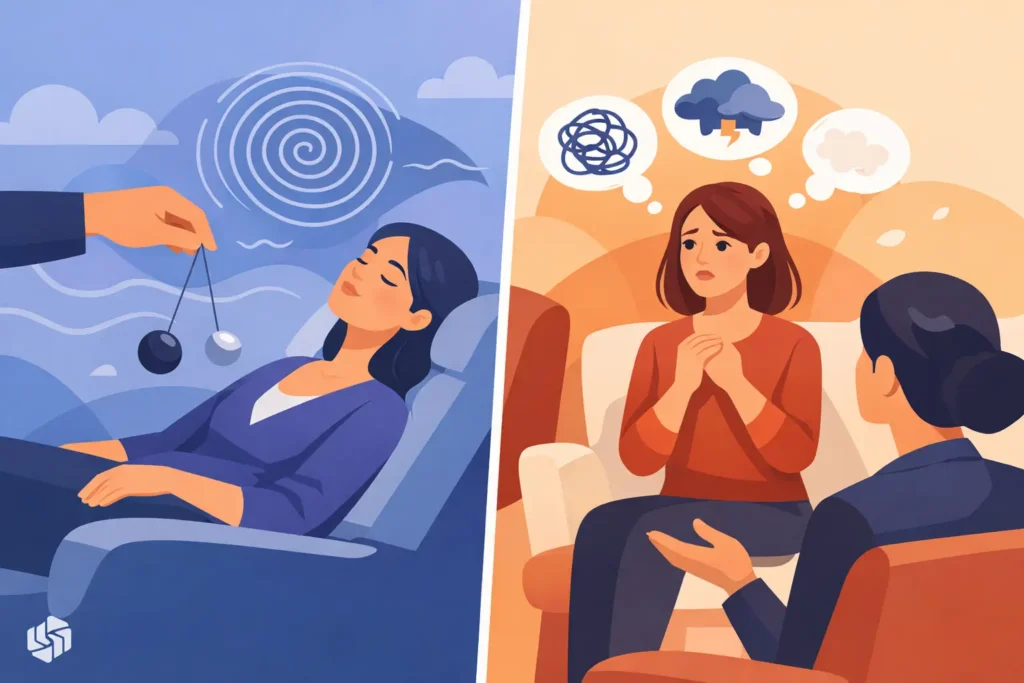
When anxiety is running your life, the last thing you need is more confusion about what kind of help to choose. If you have been comparing hypnotherapy vs counselling anxiety support, you are probably not looking for theory. You want to know what works, what feels right, and what is most likely to help you feel calm, in control and like yourself again.
The truth is, both can help. But they help in different ways, and for different people, at different points in their journey. The best choice often depends on whether you need space to talk, tools to cope, or a more direct way to change the patterns driving your anxiety in the first place.
Hypnotherapy vs counselling anxiety: what is the real difference?
Counselling usually focuses on talking through what you are feeling, what has happened to you, and how those experiences affect your thoughts, emotions and relationships. It can be incredibly valuable when someone has been carrying stress, grief, overwhelm or emotional pain for years and has never had the chance to process it properly.
Hypnotherapy tends to work differently. Rather than staying mainly at the level of conscious discussion, it aims to work with the unconscious patterns behind anxiety. That matters because many anxious reactions are automatic. You know the feeling is irrational, but your body still races, your chest tightens, your mind spirals, and the same old fear takes over.
This is why some people spend months understanding their anxiety but still feel stuck with it. Insight is useful, but insight on its own does not always switch off the alarm system.
A good hypnotherapist will often combine relaxation, focused attention, suggestion, mindset work and practical change techniques to help the brain respond differently. In simple terms, counselling often helps you understand the story. Hypnotherapy often helps change the pattern.
When counselling may be the better fit
Counselling can be a strong choice if your anxiety is tied up with relationships, loss, major life stress, identity issues or a need to be heard without pressure. Some people have spent years pushing everything down. For them, talking is not a small thing. It is the starting point.
It can also suit people who are not ready for a more direct change-based approach. If someone feels emotionally raw, uncertain, or wary of doing anything that feels too fast, counselling may feel safer and more familiar. That sense of safety matters.
There is another point worth saying plainly. Some people need ongoing emotional support as they rebuild confidence and stability. Counselling can provide that regular space. It is not always about quick change. Sometimes it is about steady change.
That said, one frustration people sometimes experience is that they can end up revisiting the same problems repeatedly without feeling much real shift in day-to-day symptoms. They understand more, but still avoid driving, still dread social situations, still wake at 3am with their mind racing. That does not mean counselling has failed. It means it may not be addressing the full mechanism of the anxiety.
When hypnotherapy may be the better fit for anxiety
Hypnotherapy can be especially useful when anxiety shows up as strong automatic reactions. That might be panic, social anxiety, driving anxiety, fear of flying, health anxiety, performance nerves, sleep issues, or the constant sense of being on edge for no clear reason.
In cases like these, people often say things such as, “I know it sounds silly, but I still feel it,” or “I can talk myself through it, but my body does not listen.” That is often a clue that the problem sits deeper than logic.
This is where hypnotherapy can be powerful. It is not about being asleep, out of control or made to do anything strange. It is about getting your mind and body into a calmer, more receptive state so the unhelpful pattern can be interrupted and replaced.
For many clients, that feels like a relief. Instead of endlessly discussing the problem, they begin training the mind out of it. They start responding differently. They stop feeding the old fear. They feel more in charge.
At Derek Chapman Hypnotherapy, the focus is not on keeping people stuck in their story. It is on helping them create meaningful change quickly, often in far less time than they expected, while still being treated with care and respect.
Is hypnotherapy faster than counselling for anxiety?
Often, yes. But faster does not always mean better for every person.
Hypnotherapy is usually more change-focused from the outset. The aim is to identify the pattern, understand what is maintaining it, and begin shifting it. That can make it attractive for people who feel exhausted by anxiety and want practical progress rather than open-ended exploration.
Counselling can take longer because its purpose is often broader. It may help with self-awareness, emotional processing, relationship insight and coping over time. That can be deeply worthwhile, especially if anxiety is part of a more complex emotional picture.
The better question is not simply, “Which is faster?” It is, “What exactly do I need help with right now?”
If you need a place to speak openly and make sense of your life, counselling may be right. If you want to reduce anxious symptoms, break the fear response and feel different in daily situations, hypnotherapy may be the more direct route.
Hypnotherapy vs counselling for anxiety attacks and panic
Panic is one area where the difference becomes very clear. Panic attacks are intensely physical. Your body reacts as if danger is present, even when you are safe. Your heart pounds, breathing changes, your thoughts turn catastrophic, and then you start fearing the fear itself.
Counselling can help you understand panic and feel supported around it. That has value. But panic is often maintained by conditioned responses in the body and mind. Hypnotherapy is well suited to this because it works with those automatic reactions rather than only the conscious interpretation of them.
That does not mean every panic problem should be treated the same way. If panic is connected to unresolved trauma, the work may need a more tailored approach. This is where practitioner skill matters. Anxiety is not one-size-fits-all, and neither is therapy.
What if you have already tried talking therapy?
This is more common than you might think. Plenty of people arrive feeling defeated because they have talked, analysed, read books, tried to be sensible, and still feel hijacked by anxiety.
That does not mean they are broken. It usually means the method has not fully matched the problem.
If your anxiety feels hard-wired, repetitive, or triggered before you even have time to think, a more unconscious-level approach may make more sense. Hypnotherapy can work well for people who are tired of knowing better but not feeling better.
Equally, if you tried counselling at the wrong time, with the wrong person, or without a clear goal, that does not mean counselling could never help you. The same is true in reverse. One poor experience should not decide your future.
How to choose between counselling and hypnotherapy
Start by being honest about what you want. Not what sounds sensible. What you actually want.
If you want space to explore emotions, be heard, and gradually understand yourself better, counselling may be a good fit. If you want to change a pattern that is interfering with work, travel, sleep, confidence or everyday life, hypnotherapy may suit you better.
Also think about your relationship with anxiety. Do you mainly need support, or do you need change? Are you looking to process what happened, or stop reliving the same reaction? Do you want an open-ended conversation, or a structured route forward?
The strongest therapy is not the one with the best label. It is the one that matches your needs and is delivered by someone who understands how anxiety really works.
The right help should move you forward
There is no medal for struggling on with the wrong approach. If something has helped you understand your anxiety but not overcome it, it is reasonable to look for a different way.
Hypnotherapy vs counselling anxiety is not really a battle of which one is superior. It is about choosing the right tool for the job. For some, that will be counselling. For many people who are stuck in automatic fear patterns, hypnotherapy can offer a more direct and empowering route to change.
If anxiety has been shrinking your life, the important thing is not picking the perfect label. It is taking the next step towards feeling calm, capable and back in control.