
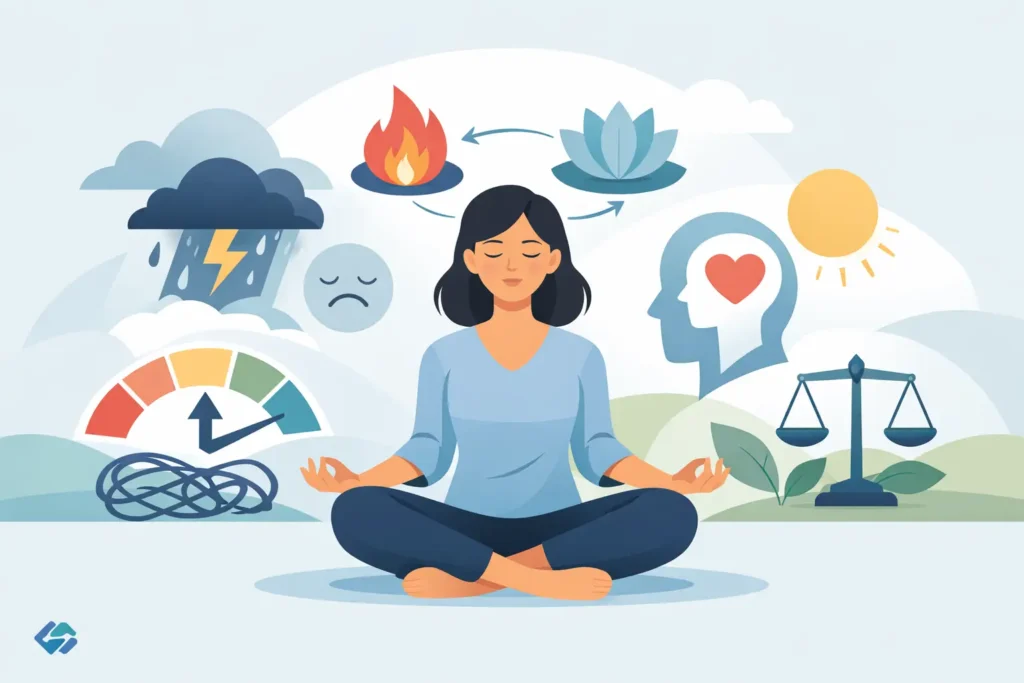
Some people do not have an anger problem, an anxiety problem or a confidence problem. They have a regulation problem. That matters, because if you try to fix the wrong thing, you stay stuck.
This guide to emotional regulation is for people who are tired of feeling hijacked by their own reactions. Maybe you snap at home, freeze in conversations, spiral at night, overthink every message, or reach for food, drink, gambling or old habits just to get a bit of relief. You might look fine on the outside and still feel as if your inner world is running the show.
That is exhausting. It also makes life feel smaller than it should.
What emotional regulation actually means
Emotional regulation is your ability to notice what you feel, stay steady enough to think clearly, and respond in a way that helps rather than harms. It does not mean being calm all the time. It does not mean becoming numb. And it definitely does not mean pretending everything is fine.
It means your feelings stop driving the car.
When regulation is working well, you can feel pressure without panicking, frustration without exploding, sadness without collapsing into it, and fear without immediately avoiding what matters. You still feel things. You just have more choice in what happens next.
When regulation is poor, emotions become urgent. Everything feels bigger, louder and more personal. A small comment feels like rejection. One mistake feels like proof that you are failing. A stressful day turns into a row, a binge, a shutdown or another sleepless night.
Why so many people struggle with it
Most people blame themselves. They say things like, I am too sensitive, I have no self control, I always ruin things, this is just how I am. Usually that is not true.
Emotional regulation problems often start as learned survival patterns. If your system has had to deal with stress, uncertainty, criticism, fear, trauma or chaos for long enough, it adapts. It becomes quicker to react and slower to settle. That might have helped once. It becomes a problem when the pattern keeps firing long after the danger has passed.
This is one reason talking yourself out of it often does not work. You can know you are safe and still feel on edge. You can know a craving will pass and still feel pulled towards it. You can know your partner is not attacking you and still react as if they are.
The thinking part of you is not broken. It is just being overruled by an older, faster pattern.
That is also why many people feel frustrated after trying to manage symptoms for years. Breathing exercises, positive thinking and distraction can help in the moment, but they do not always change the deeper response. If the system underneath is still primed, the same loop tends to come back.
A better way to think about emotional regulation
Here is the reframe that helps. Your reaction is not random. It is patterned.
That is good news, because patterns can be changed.
If you tend to panic before sleep, there will be a trigger and a sequence. If you always shut down when challenged, there will be a trigger and a sequence. If you go from stress to craving to regret, there will be a trigger and a sequence. Once you stop treating it like a personality flaw and start seeing it as a conditioned response, you can do something useful with it.
Real change begins when you move from blame to understanding, and from understanding to action.
A practical guide to emotional regulation in real life
The first step is to catch the reaction earlier. Not perfectly, just earlier. Most people notice a problem when they are already at eight out of ten. At that point, clear thinking is harder. Start learning your earlier signs instead.
For some people it is a tight chest. For others it is a clenched jaw, a racing mind, shallow breathing, irritation, restlessness or the urge to get away. Those signs matter because they give you a window. The earlier you spot the state change, the more influence you have over what happens next.
The second step is to stop arguing with the feeling. This sounds odd, but it works. If your mind is saying, do not feel this, calm down, what is wrong with you, you add pressure to pressure. A better response is simple and steady. Say to yourself, I can feel this and still choose what I do next. That puts you back in the position of responding rather than reacting.
The third step is to regulate the body before you try to solve the story. This is where many people get it backwards. They try to think their way out of a body state that is too activated. Start with the physical side first. Slow your breathing. Drop your shoulders. Unclench your hands. Sit down instead of pacing. Put both feet on the floor. Keep your voice lower than the feeling wants it to be.
None of that is magic. It simply sends a message that the danger is not what your system thinks it is.
The fourth step is to reduce the speed of the moment. Emotional dysregulation loves urgency. It tells you to reply now, leave now, drink now, spend now, check now, fix this now. If you can create even a short pause, you break the automatic chain. A few minutes can be enough to stop a row getting worse or a craving turning into a setback.
The fifth step is to look at the pattern honestly. Ask yourself what this reaction is trying to do for you. Is it protecting you from embarrassment? Trying to get relief? Avoiding rejection? Creating numbness? Keeping control? When you know the job the pattern is doing, you can build a better replacement.
That replacement needs to be practical. If stress pushes you towards alcohol, food or gambling, the answer is not simply do not do it. You need another way to change state quickly. That might be leaving the room, changing the environment, speaking to someone safe, moving your body, or using a short mental reset. The best replacement is the one you will actually use under pressure.
What gets in the way
One problem is expecting yourself to be calm straight away. Regulation is not about becoming saintly. It is about recovering faster and causing less damage while you recover.
Another problem is using regulation as avoidance. There is a difference between settling yourself and shrinking your life. If you regulate only so you can avoid difficult conversations, social situations or proper decisions, the fear stays in charge. Sometimes the right move is to calm the system and then do the hard thing anyway.
There is also the issue of old unresolved material. If your reactions are intense, repetitive and out of proportion, there may be more going on underneath than stress management can reach. In those cases, the most effective route is often to update the deeper pattern rather than spending years trying to outmanoeuvre it.
That is where structured change work can make a real difference. You do not always need endless analysis, and you do not necessarily need to keep revisiting the past in detail. Often the goal is simpler than that. Find the driver. Change the response. Give the mind and body a better pattern to run.
When to get help with emotional regulation
If your reactions are affecting your sleep, work, relationships, confidence or health, it is worth dealing with properly. The same applies if you keep promising yourself you will stop a behaviour and then doing it again. That cycle wears people down because it starts to feel personal. It is not weakness. It is a pattern that has more control than you want it to have.
Good help should feel practical, clear and focused. You should not be left dependent on coping strategies forever. The aim is not to manage your life around the problem. The aim is to change the problem at the level it is happening.
That will look different for different people. Some need help calming a system that is constantly switched on. Some need to remove the emotional charge from old experiences. Some need to break a habit loop that has become wired to relief. It depends on what is driving it. But the principle stays the same. If you change the driver, the symptoms stop needing so much management.
If you have been stuck for a while, take that seriously. Not as bad news, but as information. It may mean the issue needs a more direct approach than advice, reassurance or willpower.
You are not meant to spend your life bracing for your own reactions. Feeling calmer, clearer and more in control is not too much to ask. It is often what becomes possible when the right pattern is changed.
Ready to experience real change or keep repeating the same pattern? Book your Real Change Meeting here (https://Derekmindcoach.as.me/)