
If you are weighing up mind coaching vs therapy, chances are this is not a theoretical question. Something in your life is not working as it should. You may be stuck in anxiety, repeating the same habits, avoiding situations you know you should be able to handle, or feeling as though your mind keeps pulling you back into old patterns. When that is happening, you do not need jargon. You need to know what kind of help is actually likely to move things forward.
Mind coaching vs therapy – what is the real difference?
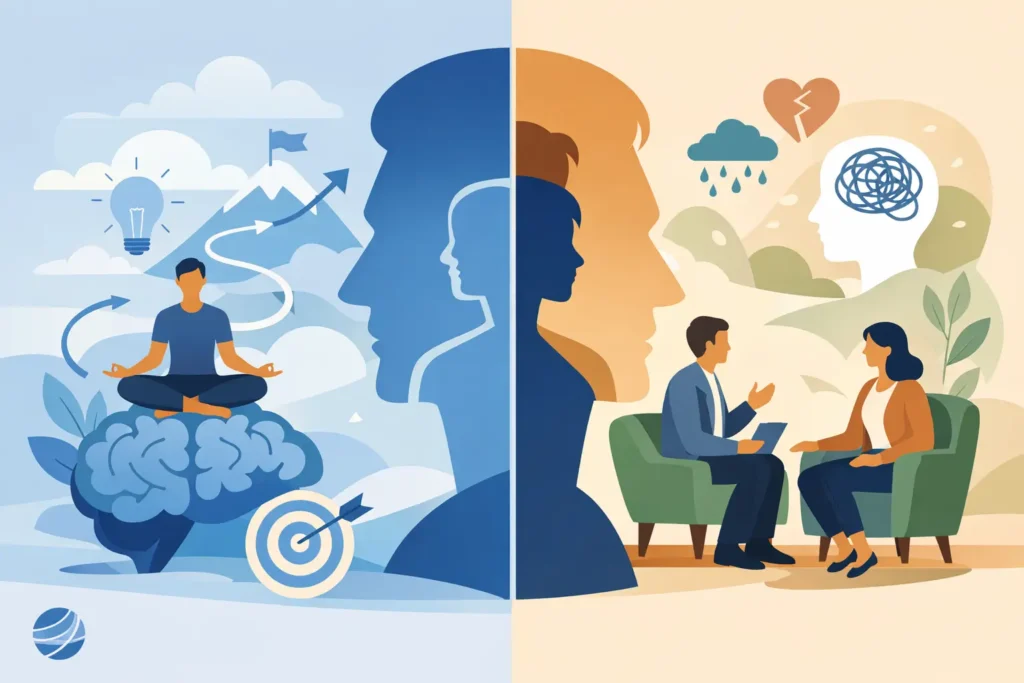
The simplest way to understand it is this. Therapy often focuses on emotional healing, symptom relief and making sense of what is going on beneath the surface. Mind coaching is usually more focused on changing patterns, building control and helping you move towards a different way of thinking and behaving.
That said, the line is not always neat. Good support very often includes both. A person with anxiety may need help calming the nervous system, understanding triggers and processing old experiences. They may also need practical strategies to stop avoidance, rebuild confidence and respond differently in daily life. If you split those needs too rigidly, you can miss what actually helps.
This is why the question is not really which label sounds better. The better question is whether the support in front of you is equipped to help with both the root of the issue and the pattern that keeps it alive.
What therapy tends to do best
Therapy can be especially helpful when pain, trauma, grief or emotional overwhelm are sitting at the centre of the problem. If someone has been carrying distress for years, or has experiences they have never properly processed, therapy can create space to work through that safely.
For many people, therapy is the first place they feel heard without judgement. That matters. Being able to speak honestly about panic, addiction, shame, low mood or intrusive thoughts can reduce the sense of isolation that often makes problems worse.
Therapy also tends to be useful when symptoms feel confusing. If you do not understand why you react so strongly, why your body goes into fear so quickly, or why the same relationship patterns keep showing up, therapeutic work can help make those links clearer.
But there is a trade-off. Some forms of therapy are very insight-led. They help people understand themselves better, which is valuable, but understanding alone does not always create change. Plenty of people know exactly why they struggle and still find themselves trapped in the same cycle. Insight is important. It is not always enough.
What mind coaching tends to do best
Mind coaching is often better suited to people who feel ready to change, but keep getting dragged back by fear, self-doubt or habit. It is practical by nature. The focus is less on talking around the problem and more on interrupting the pattern.
That can be powerful for confidence issues, fears, performance blocks, smoking, gambling, sleep struggles and anxiety-based avoidance. In those situations, the person usually knows what they want. They want to feel calmer, stop sabotaging themselves, or stop reacting in ways that no longer serve them. What they need is help retraining the mind and body so the old response loses its grip.
Mind coaching often works well because it is future-focused. It asks, what are you still doing that keeps this going? What belief sits underneath it? What response needs to be replaced? That shift can help people stop seeing themselves as broken and start seeing themselves as trainable.
The limitation, again, is context. If somebody is carrying unresolved trauma, deep emotional distress or complex mental health difficulties, coaching on its own may not go deep enough. You cannot simply coach your way past pain that still needs proper processing.
Why this matters for anxiety, trauma and habits
This is where many people get frustrated. They have tried one route, not had the breakthrough they hoped for, and start to believe nothing will work for them. Usually that is not the truth. Usually they just have not had the right approach.
Take anxiety as an example. If anxiety is being fuelled by old experiences, chronic stress and a deeply conditioned fear response, then talking positively to yourself will not touch the root. But if you only explore the past without changing the conditioned response in the present, you may still feel stuck.
The same is true with addiction and habits. Someone might fully understand how their smoking, drinking or gambling started. They may know the emotional triggers. They may even be highly motivated to stop. But if the unconscious pattern has not been changed, the urge often returns the moment stress hits.
That is why integrated work can be so effective. When support combines therapeutic depth with practical mind coaching, people are not just managing symptoms. They are changing the way the problem operates.
Mind coaching vs therapy for trauma
With trauma, caution matters. Trauma is not simply a bad memory. It is often a stored emotional and physical response that still feels active in the present. That is why people can know they are safe and still feel anything but safe.
In this area, therapy has a clear and important role. Trauma-informed methods such as EMDR and related approaches are designed to help process what has become stuck. They can reduce the emotional charge and help the nervous system stop reacting as though the danger is still happening.
Coaching can still play a part, but usually after or alongside this kind of work rather than instead of it. Once the traumatic charge begins to settle, coaching can help rebuild confidence, restore boundaries, change identity and get life moving again.
So if your problem includes trauma, the key is not to choose the most fashionable term. It is to make sure the practitioner understands trauma properly and does not mistake survival responses for lack of motivation.
What to look for in the right kind of support
The label matters less than the quality and fit of the work. Some therapists are highly practical. Some coaches work with excellent depth. Some practitioners combine clinical methods with coaching tools in a way that gives clients both relief and momentum.
A few signs are worth paying attention to. First, does the person explain clearly how they work, in plain English? If you are already overwhelmed, you should not have to decode vague promises.
Second, do they understand the type of issue you are dealing with? Anxiety, trauma, addiction, phobias and confidence problems may overlap, but they are not all approached in exactly the same way.
Third, does the support feel active? Not rushed, not pushy, but active. Real change usually involves more than being listened to. It involves a clear process that helps your mind and body respond differently.
And finally, do you feel safe enough to be honest? Trust matters. People change faster when they do not feel judged.
When a blended approach makes more sense
For many people, mind coaching vs therapy is the wrong battle entirely because the best results come from blending the two. If someone is carrying anxiety, low confidence and a specific fear, they may need emotional regulation, belief change and behavioural rewiring. That is not unusual. It is actually common.
This is where approaches such as hypnotherapy can be valuable. Used well, hypnotherapy is not about losing control. It is about working with the unconscious patterns that logic alone often fails to shift. Combined with practical coaching and, where needed, trauma-informed methods, it can help people make meaningful changes faster than they expected.
That is also why some people make progress after years of trying other routes. The issue was not that they were beyond help. It was that nobody had yet worked with both the emotional cause and the learned pattern in the same process.
At Derek Chapman Hypnotherapy, that combination is central to the work – helping people change the beliefs, triggers and unconscious responses that keep them stuck, rather than just coping with them.
How to decide what fits you now
Ask yourself a more honest question than, do I want therapy or coaching? Ask, what is most true for me at the moment?
If you feel emotionally flooded, weighed down by trauma, or unable to make sense of your reactions, therapy-led support may be the right starting point. If you feel stuck in a clear pattern and want focused help changing it, mind coaching may be a better fit. If you recognise both – pain underneath and a pattern on top – then a blended approach is likely to serve you best.
You do not need to choose perfectly on paper. You need support that understands what is driving the problem and knows how to help you change it.
The right help should leave you feeling more hopeful, more in control and more certain that your issue is changeable than you did before you asked for it.