
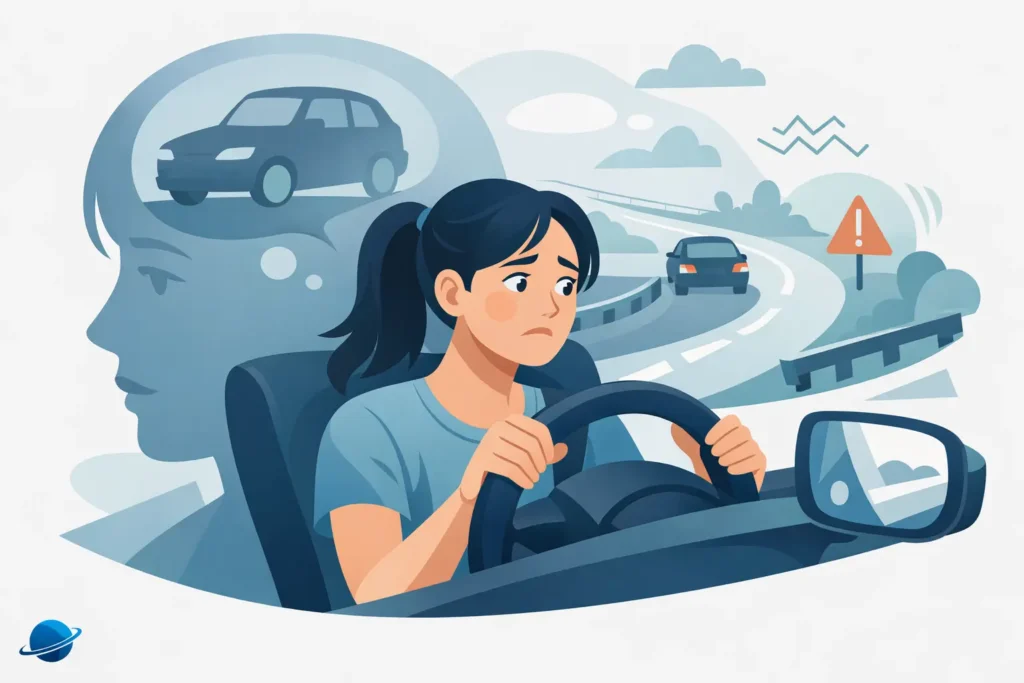
That moment matters more than most people realise. You sit in the driver’s seat, hands already tense, heart racing before the engine even starts, and your mind is telling you that something bad is about to happen. If you are searching for how to overcome driving phobia, chances are you are not looking for theory. You want to feel normal again.
Driving phobia can shrink your life very quickly. Work becomes harder. School runs feel impossible. Visits to family get avoided. Even being a passenger can start to feel uncomfortable because your system is on alert the whole time. What starts as fear of one road, one roundabout or one bad journey can spread until the whole idea of driving feels unsafe.
The frustrating part is that many people with this fear know it does not make logical sense. They know the route. They know the car is fine. They know other people drive every day without panic. But fear does not run on logic. It runs on association, memory and protection.
Why driving phobia feels so strong
A driving phobia is not a weakness and it is not you being dramatic. It is your system learning to connect driving with danger. That can happen after an accident, a near miss, a panic attack at the wheel, or even after a stressful period where your nervous system is already overloaded.
Sometimes there is no obvious event. The fear builds quietly. You feel a bit trapped in traffic one day. A bit lightheaded on a dual carriageway the next. Then you start watching yourself too closely. Your breathing changes. Your chest tightens. Your brain notices that change and decides driving must be the problem. From there, the fear gets reinforced each time you avoid it or push through it in a state of panic.
That is why people often say, “I used to be fine. I do not know what happened.” Something did happen, even if it was subtle. Your mind linked driving to threat, and now it is trying to protect you.
How to overcome driving phobia starts with the right reframe
Most people try to solve this by forcing themselves to be brave. They grit their teeth, go for a drive, feel awful, come home shaken, and then think they have failed. They have not failed. They have simply repeated the fear pattern.
To understand how to overcome driving phobia, you need to stop treating the fear as proof that you cannot drive. The fear is proof that your system has learnt a response. Learnt responses can be changed.
That matters, because once you stop seeing the problem as part of your identity, it becomes much easier to deal with. You are not a bad driver. You are not broken. You are someone whose brain has attached too much danger to a normal activity.
There is also a difference between respecting driving and fearing it. Good drivers stay aware. Phobic drivers stay on guard. Awareness helps you respond. Hypervigilance makes you feel worse and less in control.
What keeps the pattern going
Driving phobia is rarely just about the road. It is usually about what your mind believes might happen if you feel anxious while driving.
For one person, it is the fear of crashing. For another, it is the fear of panicking and not being able to escape. For someone else, it is the fear of fainting, losing control, making a fool of themselves or harming a loved one in the car. The details vary, but the pattern is similar.
You feel a sensation. You interpret it as danger. Your body reacts more strongly. You then fear the reaction itself.
That is when life gets smaller. You start changing routes. Avoiding motorways. Only driving with someone else in the car. Staying close to home. Leaving early to avoid traffic. Then maybe stopping altogether.
Those adjustments feel sensible in the moment, but they teach your mind that avoidance kept you safe. The phobia gets stronger because it never gets properly updated.
How to overcome driving phobia without making it worse
The answer is not to throw yourself into the deepest end and hope for the best. It is also not to spend years analysing every possible reason for the fear while your world keeps shrinking.
The most effective approach is to work on both the trigger and the response.
You need to reduce the emotional charge around driving itself, and you need to stop your body reacting as if normal anxiety sensations are dangerous. If only one part changes, the problem can hang around.
That is why purely practical advice only gets some people so far. Yes, it helps to start small. Yes, it helps to build confidence gradually. But if the original fear pattern is still active underneath, progress can feel slow, fragile or exhausting.
In real terms, that means a proper solution often involves updating the unconscious response, not just talking about it. When that happens, people often notice something simple but powerful. They stop bracing.
A practical way forward
If you want to begin changing this, start where the fear is manageable, not where it is overwhelming. That might mean sitting in the parked car calmly. It might mean driving to the end of the street. It might mean repeating a short, familiar route until your body stops treating it like a threat.
The key is not distance. The key is the state you are in while doing it.
If every attempt becomes a white knuckle endurance test, your mind is still learning that driving equals distress. If you can bring your system down and then repeat safe experiences, the pattern starts to loosen.
Keep your focus narrow. Do not ask, “How will I ever drive on the motorway again?” Ask, “Can I do the next five minutes differently?” Fear loves the big picture. Change happens in smaller pieces.
It also helps to stop monitoring yourself so intensely. The more you check your heartbeat, breathing, dizziness or thoughts, the more threatened you will feel. Let sensations be there without treating them like an emergency. Anxiety rises faster when you argue with it.
This does not mean pretending to be relaxed when you are not. It means not adding a second layer of fear on top of the first one.
When the fear came after a bad experience
If your driving phobia started after an accident, near miss or panic attack, there is often a memory element that needs updating. You may be reacting not just to driving now, but to what your system still thinks is happening.
That is why some people can understand perfectly well that the event is over and still react as though it is not. The body can hold on to old danger signals long after the conscious mind has moved on.
This is also why reassurance from family often does not fix it. They say, “You’re safe,” but your nervous system does not believe them. It is running an old pattern.
When that pattern is properly worked on, people often feel a shift quite quickly. Not because they have been talked into being confident, but because the fear response has actually changed.
If you have tried before and nothing stuck
Many people struggling with driving phobia have already tried common advice. They have had lessons. Read tips. Used breathing exercises. Forced themselves to keep going. Some have even had therapy and still feel stuck.
That does not mean the problem is permanent. It usually means the approach did not get to the part of the mind creating the reaction.
This is where direct, results focused work can make a real difference. You do not need endless sessions retelling your life story. You need the fear pattern identified and changed properly, so your response behind the wheel starts to match the reality of the situation.
That is the difference between coping and changing.
And yes, there is a place for practical steps. But if you are someone who is exhausted by managing the fear, you may need more than coping strategies. You may need help updating the reason the fear keeps firing in the first place.
How to know you are improving
Progress is not always dramatic at first. Sometimes it shows up as less dread the night before. Less overthinking before a journey. Less tension at a roundabout. The route that used to feel impossible starts to feel merely uncomfortable, then routine.
That is real progress.
Confidence is not something you wait to feel before driving. Confidence grows when your mind learns, through repeated experience and the right support, that driving no longer needs a panic response.
So if you have been asking how to overcome driving phobia, start with this. Stop seeing the fear as who you are. See it as a pattern that can be changed. The problem is not that you cannot cope. The problem is that your system is overprotecting you.
And overprotection can be updated.
Ready to experience real change or keep repeating the same pattern? Book your Real Change Meeting here https://Derekmindcoach.as.me/Meeting-60mins