
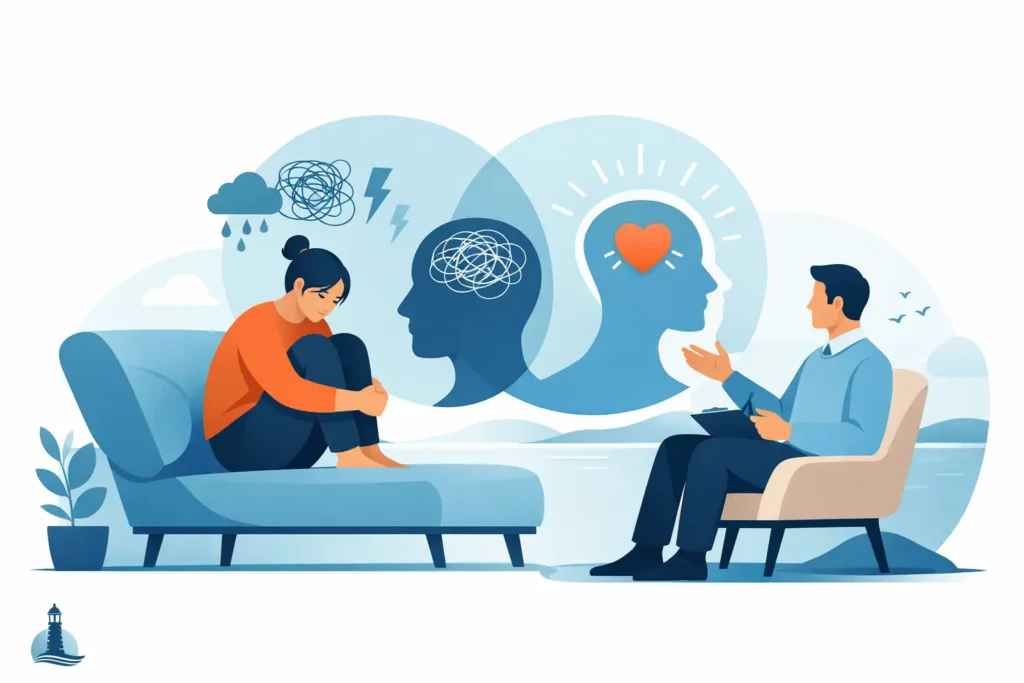
If your mind is always switched on, your body feels tense for no clear reason, and the smallest thing can tip you into panic, you do not need another lecture about stress. You need anxiety treatment Grimsby people can actually use to feel different, not just understand the problem a bit better.
That matters because anxiety is rarely just one thing. It can show up as overthinking, dread, poor sleep, irritability, chest tightness, avoiding places, checking everything twice, or feeling on edge even when life looks fine from the outside. For some people it hits at work. For others it kicks in when they are driving, shopping, speaking up, travelling, or trying to switch off at night. It can make you feel weak, but that is not what is going on.
When anxiety starts running your life
Most people do not ask for help the first time anxiety appears. They try to push through. They tell themselves to get on with it. They hope it will pass. Then weeks turn into months, and what started as feeling stressed becomes a pattern.
You stop doing certain things because they set you off. You plan your day around how safe or manageable it feels. You avoid situations that used to be normal. You become more aware of your body, more alert to every sensation, more worried that something is wrong. That is when anxiety gets bigger. Not because you are broken, but because your system has learned a pattern and keeps repeating it.
This is one reason anxiety can be so frustrating. You can know logically that you are safe and still feel completely flooded. You can be told to breathe, relax, think positive, or challenge your thoughts, and yet part of you still reacts as if there is danger. That gap between what you know and what you feel is where many people get stuck.
Why anxiety happens in the first place
Anxiety is not random. It is your mind and body trying to protect you, but doing it in a way that has become exaggerated, outdated, or attached to the wrong trigger.
Sometimes there is a clear reason. A bad experience, a period of stress, grief, illness, a relationship breakdown, work pressure, burnout, or a shock to the system can leave the brain on high alert. Other times it has built up over years through habits of worry, people pleasing, perfectionism, low confidence, or always feeling you have to hold everything together.
Then there is the part many people miss. Anxiety is often driven by the unconscious mind, not just conscious thinking. That means you can talk about it for years and still react the same way because the deeper pattern has not changed. If your system has learned that certain situations equal danger, it will keep firing off the same alarm until that pattern is updated.
That is why reassurance often works only briefly. It calms things down for the moment, then the anxiety returns. The root of the response is still there.
Anxiety treatment in Grimsby should do more than help you cope
There is nothing wrong with wanting relief. In fact, most people seeking anxiety treatment in Grimsby are past the point of wanting more coping tips. They want to feel normal again. They want to get through the day without that constant knot in the stomach. They want to stop scanning for problems. They want proper change.
This is where the approach matters.
If treatment is only about managing symptoms, you may become better at getting through anxious moments while still living underneath the same pattern. That can help in the short term, but it is not always enough. For many people, the real shift comes when the mind stops treating ordinary life like a threat.
That means working with the part of the brain that has learned the anxiety, not just the part of you that can describe it.
What effective anxiety treatment Grimsby clients need often looks like
Good anxiety treatment is not about keeping you dependent on support. It is about helping you understand what is driving the pattern, change it properly, and get your life back.
That may involve a mix of approaches rather than one rigid method. Some people respond well to hypnotherapy because it helps calm the system and change old associations at an unconscious level. Others benefit from mind coaching to break repeated mental habits and build stronger internal responses. Trauma based anxiety may need a different route, especially if the nervous system is stuck reacting to something that has never been fully processed.
This is where methods such as EMDR and MEMI can be useful. They are not about endless talking. They are designed to help the brain update how it stores certain experiences so the emotional charge drops. For many people, that is a huge relief because they do not want to keep going over the past in detail. They just want the reaction to stop running their present.
It depends on the person. Anxiety linked to a specific fear or phobia may shift quite differently from anxiety linked to long term trauma, health worries, confidence issues, or deep rooted self criticism. The point is not to fit you into a system. The point is to identify what is maintaining the problem and change that.
The biggest reframe most anxious people need
You are not the problem. The pattern is.
That distinction matters because anxiety often becomes personal. People start saying, this is just how I am, I have always been anxious, I cannot cope, I am not confident, I am the sort of person who panics. But those are conclusions built from repeated experience, not fixed truths.
When a pattern has repeated enough times, it can feel like your identity. It is not. It is learned. And what is learned can be changed.
This is also why willpower alone usually fails. You cannot bully your nervous system into feeling safe. If anxiety were solved by trying harder, most people would have fixed it already. Change happens when the underlying response changes and your mind and body stop rehearsing the same old survival loop.
That is often the turning point. People stop seeing themselves as broken and start seeing the problem as something specific, understandable, and treatable.
What real progress often feels like
Real change is not always dramatic in the moment. Sometimes it is surprisingly ordinary. You notice you slept better. You drive somewhere without the usual dread. You go into a shop and your chest stays calm. You stop checking your phone, your symptoms, your exits, your pulse. You handle a situation that would normally throw you, and only afterwards realise it did not take over.
That is how confidence starts coming back. Not from forcing positive thinking, but from new evidence. Your system begins to learn that you can do life differently now.
For some, progress is quick. For others, especially where anxiety has been wrapped up with trauma, addiction, or years of avoidance, the route needs a bit more care. Fast does not mean rushed, and deeper work does not mean endless. What matters is whether the process is focused, structured, and aimed at meaningful change rather than keeping you in analysis.
That is one reason many people are drawn to practical one to one work. It feels personal. It is adapted to what is actually happening. And it respects the fact that most clients are not turning up for theory. They are turning up because they are fed up of losing days, energy, sleep, opportunities, and peace of mind to a pattern that no longer makes sense.
Choosing anxiety treatment in Grimsby
If you are looking at anxiety treatment in Grimsby, the best question is not simply what label the practitioner uses. Ask whether the work is likely to change the pattern or just help you manage around it.
Ask whether the approach is direct, clear, and results focused. Ask whether you feel understood without being drawn into endless explanation. Ask whether the person in front of you can spot what is really driving the issue rather than just discussing symptoms.
Experience matters too. So does trust. When someone has worked with thousands of clients and built that reputation through real results, it tells you something important. Not that every case is identical, because it is not, but that change is possible even when people have felt stuck for a long time.
And if getting help locally feels difficult, there is another thing worth remembering. Effective anxiety work does not always have to happen in the same room. For many people, Zoom sessions make it easier to start, especially when travel, panic, work, or family pressures have made face to face support feel like one more obstacle.
Anxiety shrinks life by convincing you that small things are dangerous and bigger things are impossible. The right work does the opposite. It helps you feel safe enough to think clearly, respond differently, and take your life back one real step at a time.
Ready to experience real change or keep repeating the same pattern? Book your Real Change Meeting here https://Derekmindcoach.as.me/