
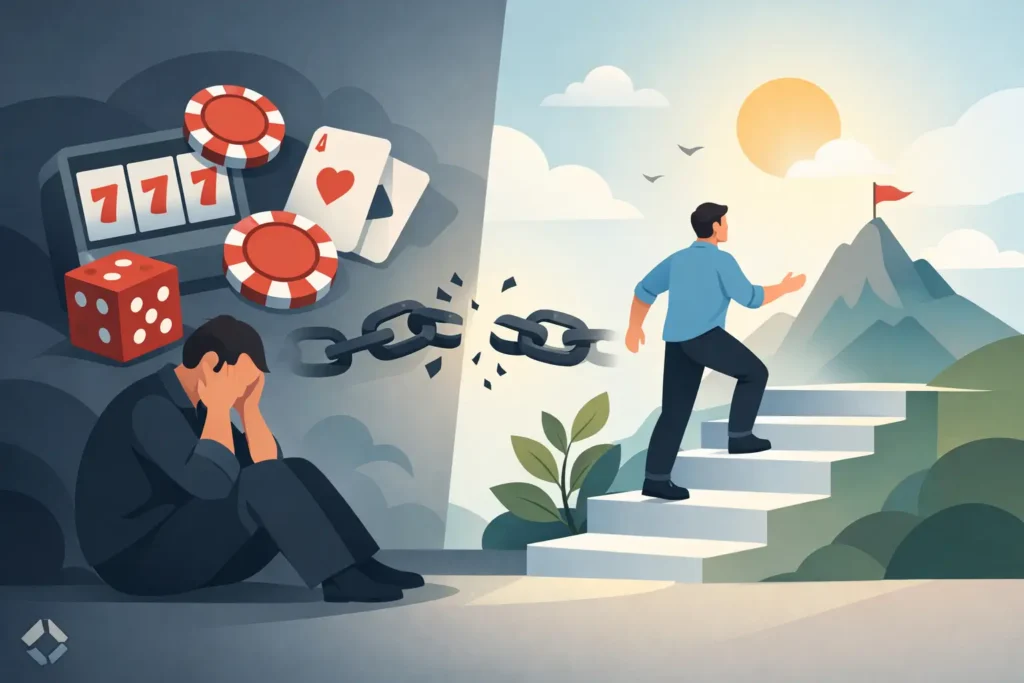
One of the hardest parts of gambling addiction is how normal it can look from the outside. Someone can still go to work, still smile, still tell themselves they have got it under control, while inside they are panicking, hiding losses and chasing one more win that never fixes anything. If you are looking for a gambling addiction recovery example, what you probably want is not theory. You want to know whether change is actually possible when life has started to revolve around bets, shame and broken promises.
It is. But not usually by relying on willpower alone.
A gambling addiction recovery example in real life terms
Think of a man in his forties. He has a job, a partner and kids. It started small with football accumulators and the odd online casino app late at night. At first it felt like a release. A bit of excitement. A way to switch off.
Then stress at work got worse. Money felt tighter. Home felt tense. Gambling stopped being entertainment and became escape. When he felt pressure, he bet. When he felt guilty about betting, he bet again to try to win it back. When he lost, he hid it. When he hid it, the shame grew. Then he needed another hit of hope just to feel normal again.
That is the part many people miss. Gambling addiction is not just about money. It is about state. It is about what your mind has learned to do when you feel trapped, flat, anxious, angry or not enough.
In this example, he had tried to stop many times. He deleted apps, handed over bank cards, swore he was done. For a week or two he meant it. Then something triggered him. A row. A bad day. A feeling he could not settle. Back he went.
This is where people start calling themselves weak. They are not weak. They are stuck in a pattern that has gone deeper than logic.
The real problem is not just the gambling
If gambling were only a bad habit, a stern talk and a bit of discipline would sort it. But for many people, the gambling is the visible part of a much bigger loop.
Underneath it, there is often anxiety, old stress, low mood, trauma, pressure, fear of failure or the constant feeling of never quite being enough. The gambling becomes a fast acting state changer. It gives relief, distraction, focus or a rush. Even when it ruins things, the mind still remembers that for a few moments it changed how you felt.
That is why people can know the damage and still do it again. Part of them hates it. Another part has learnt to treat it like a solution.
Families often struggle with this. They think, if he can see what it is doing, why does he keep going back? The answer is simple, even if it is painful. Because the unconscious mind is still linking gambling with relief. Until that changes, stopping can feel like losing the only thing that helps, even when that thing is destroying your life.
Why gambling addiction recovery can feel harder than people expect
A lot of people try to recover by focusing only on the behaviour. They block websites, avoid cash points, ask someone else to manage finances. Those steps can help. They are sensible. But they do not always change the urge.
So the person behaves for a while, white knuckles through it, then slips when emotion gets too strong.
That is why recovery often feels so frustrating. You can do everything right on the surface and still feel pulled back because the deeper driver has not shifted. The trigger is still there. The emotional pattern is still live. The part of you that reaches for gambling as a release has not been updated.
This is also why endless talking does not suit everyone. Some people already understand exactly why they should stop. They can explain the damage in detail. They just cannot seem to break the pattern for good.
They do not need more lectures. They need change at the level where the habit is running.
The turning point in this gambling addiction recovery example
In the example above, the turning point was not some dramatic rock bottom moment. It was quieter than that. He got tired of being split in two.
One side of him wanted to be present, honest and calm. The other side kept dragging him back into secrecy, panic and false hope. He was exhausted by the lying, the checking, the stomach drops, the mental maths, the promises and the fear of being found out.
What changed things was looking beyond the bets and dealing with what was driving them. The work focused on the emotional triggers, the learnt response, the sense of pressure and the internal state he had been trying to escape. Instead of treating gambling as the whole problem, it was treated as the strategy his mind had adopted.
That matters because once the strategy stops making sense to the unconscious mind, the pull can drop fast.
This is where proper structured change work can make a huge difference. When you calm the nervous system, reduce the emotional charge behind the urge and update the old pattern, the person no longer has to fight themselves all day. They can think clearly again. They can respond instead of react.
What recovery actually looked like
Recovery did not mean he suddenly became a different person overnight. It meant the compulsion stopped running the show.
He was able to sit with stress without reaching for his mobile phone. He stopped chasing losses because the trance of maybe this one will fix it began to break. He started being honest at home because honesty no longer felt more dangerous than the addiction itself. Sleep improved. Anxiety dropped. The constant background noise in his head eased.
Something else changed too. He stopped seeing himself as a failure who gambled and started seeing himself as a person who had learnt a destructive coping pattern and could now change it.
That shift is not just motivational language. It matters. Shame keeps addiction stuck. Shame says this is who I am. Real recovery says this is what I learnt to do, and what is learnt can be unlearnt.
There were still moments to manage. Recovery is not about pretending life never feels hard again. Stress still happened. Temptation still showed up now and then. But the old automatic loop had weakened. He had tools, awareness and a different internal response.
That is a much stronger place than trying to survive on guilt and self-control.
What this gambling addiction recovery example shows
The biggest lesson is this. Most people do not need more fear. They already have plenty of that. They need a way to change the pattern properly.
If you are stuck in gambling addiction, or watching someone you love go through it, stop asking only, why can they not just stop? A better question is, what is the gambling doing for them emotionally, and how do we replace that pattern at the root?
For some, the answer involves anxiety. For others, trauma, numbness, pressure or the need to feel a sense of control. It depends on the person. That is why generic advice only goes so far. The behaviour may look similar, but the driver underneath can be very different.
When the work is personalised, practical and aimed at unconscious change, recovery often starts to feel less like a battle and more like relief.
If this sounds familiar, there is a way forward
You do not have to wait until everything falls apart. You do not have to keep proving to yourself that you can stop for three days and then start again. And you do not have to spend months analysing every detail of the past if what you really want is to feel free in the present.
A good gambling addiction recovery example is not really about one person. It is about a pattern that can be changed. The names and details vary, but the loop is often the same. Stress, urge, bet, regret, promise, repeat. When that loop is interrupted at the right level, people can get their life back faster than they expected.
If you are reading this for yourself, be honest. Not harsh, just honest. Is gambling giving you relief for minutes and costing you peace for days? Is it affecting your sleep, your confidence, your relationship, your work, your self-respect? If it is, the answer is not to keep hiding it better. The answer is to change it properly.
If you are reading this for someone else, keep this in mind. Pressure and arguments rarely create lasting change on their own. Support matters, boundaries matter, honesty matters, but real change happens when the person is ready to break the pattern instead of defend it.
That is when things can move quickly.
You are not looking for a new way to cope with gambling forever. You are looking for a way to stop needing it.
Ready to experience real change or keep repeating the same pattern? Book your Real Change Meeting here https://Derekmindcoach.as.me/