
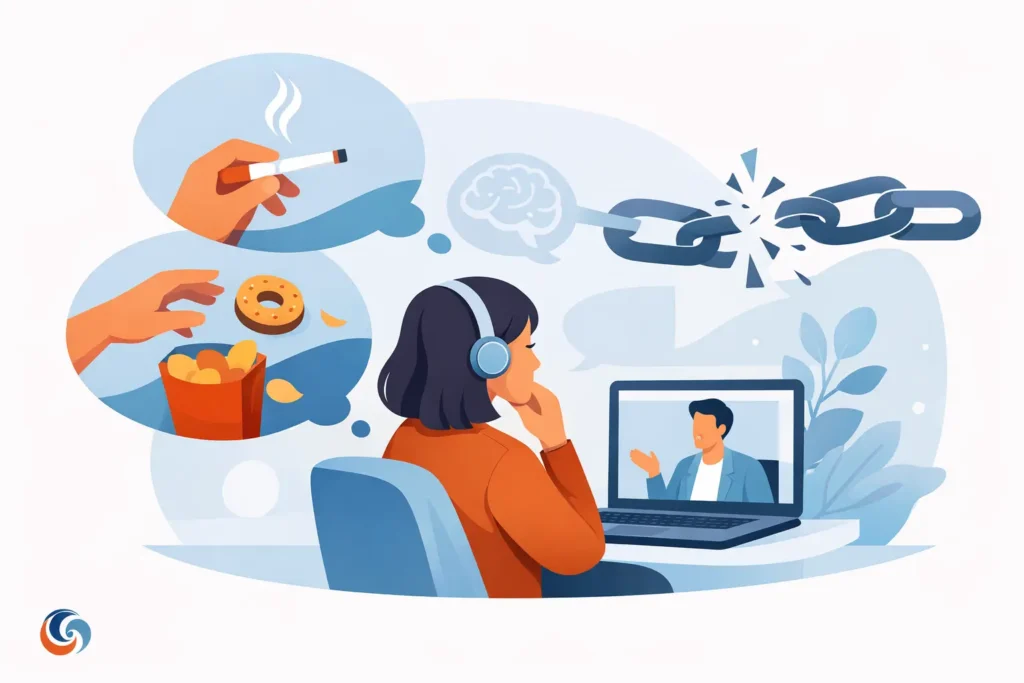
Some habits can make you feel as if you are living on repeat. You tell yourself this is the last time, you mean it, and then there you are again doing the same thing, thinking the same way, feeling the same regret. If you have been asking can online therapy stop habits, the short answer is yes, but only if the work goes deeper than talking about the habit itself.
That matters because most habits are not really about willpower. They are learnt responses. They get wired into your system because at some point they did something for you. They soothed stress, blocked out fear, gave you relief, distracted you, or helped you feel in control for a moment. Even when they are destructive, they often have a job.
Can online therapy stop habits for good?
It can, when the right method is used and the real driver is dealt with. If a habit is only being managed at the surface, change often feels temporary. You might hold it together for a week, a month, or longer, then stress hits and the old pattern comes back.
That is why some people end up feeling as though they have failed therapy, when really the therapy simply did not get to the level where the habit was being run. Talking can help you understand yourself, and understanding has value, but insight alone does not always stop an urge, switch off a trigger, or change an automatic response.
Online work can be highly effective because what matters most is not the room you are sitting in. It is the quality of the process, the skill of the practitioner, and whether the session helps your mind update the pattern properly. If those things are in place, Zoom is not a barrier. For many people it actually helps because they feel safer and more relaxed in their own space.
Why habits keep coming back
Most people think of a habit as a bad choice repeated too many times. That is only part of the picture. In real life, habits usually sit on top of something deeper.
You might overeat because food gives comfort when stress builds. You might smoke because your body has linked it with relief, space, or a sense of control. You might gamble, scroll, drink, avoid, pick, panic buy, or sabotage relationships because something inside you has learnt that this pattern helps you escape a feeling you do not want.
That feeling may be anxiety. It may be shame. It may be old fear. It may be the pressure of trying to cope while looking fine from the outside.
This is where people often get stuck. They try to remove the behaviour without changing the reason their system reaches for it. Then they feel deprived, tense, or vulnerable. The habit might stop for a while, but the pressure underneath is still there looking for a way out.
That is why real change is not about fighting yourself all day. It is about changing the pattern at the level where it starts.
What online therapy can do that self help often cannot
Self help can be useful. So can apps, podcasts, books, and good advice. But if the habit has become automatic, emotional, and deeply familiar, information is rarely enough.
You already know what you should be doing. That is not the problem.
The problem is that part of you still reacts before logic gets a say. In that moment, the habit feels stronger than the promise you made that morning. This is why people can be intelligent, motivated, successful, and still feel powerless around one pattern that keeps beating them.
Proper online therapy can interrupt that cycle. It can help identify what the habit is doing for you, what triggers it, what emotional state feeds it, and what needs to change so the urge loses its grip. When the unconscious driver changes, the behaviour becomes easier to leave behind because you are no longer relying on force alone.
For some people, that means reducing anxiety so the habit is no longer needed as a release valve. For others, it means updating old trauma responses, removing emotional charge, or changing the beliefs that keep the pattern alive.
You do not always need years of talking to create that shift. In fact, many people who come for this kind of work are tired of analysing everything and getting little relief from it.
Can online therapy stop habits if they have been there for years?
Yes, it can. Length of time does not always equal difficulty. Some habits have been around for years simply because nobody has addressed them in the right way.
People often assume a long standing problem must need a long process. Sometimes that is true, especially if there are several layers involved. But often the issue has lasted because it has been managed, tolerated, or misunderstood rather than properly changed.
I have seen people carry a pattern for decades, then shift it once the real mechanism becomes clear. That is not magic. It is what happens when the work is focused, practical, and aimed at the cause instead of the symptom.
That said, honesty matters here. Not every habit is identical, and not every person changes at the same speed. If someone is living with severe addiction, major instability at home, or multiple overlapping issues, the work may need more care and structure. Good practice is not about making wild promises. It is about knowing what will help and applying it properly.
Why Zoom can work better than people expect
A lot of people are unsure about online sessions until they try them. They imagine it will feel flat, awkward, or less effective than being in the room. Usually the opposite happens.
When people are at home, they often feel more settled. They do not have the stress of travelling, sitting in traffic, or rushing in already tense. They can speak more openly because they are in familiar surroundings. For change work that involves focus, calm, and honest attention, that can be a real advantage.
There is also something practical about online work. It makes support accessible whether you are in Grimsby, Cleethorpes, Louth, Barton, elsewhere in Lincolnshire and Humberside, or further afield. If the help is right for you, distance stops being a problem.
What matters is not the screen. It is whether the session creates a real shift.
The reframe that changes everything
If you have a habit you hate, it is easy to turn that into a judgement about yourself. Weak. Broken. Addictive. Hopeless. That kind of thinking makes change harder, not easier.
A better way to look at it is this: your mind has learnt a pattern, and anything learnt can be updated.
That does not excuse harmful behaviour. It does not remove responsibility. But it does remove the idea that you are somehow destined to stay this way.
When people understand that the habit is a response rather than their identity, they stop wasting energy on shame and start focusing on change. That is where progress begins. You do not need more guilt. You need the right intervention.
What actually helps a habit stop
The most effective work is usually structured. First, the pattern needs to be understood clearly. What triggers it? What feeling comes before it? What does it help you avoid or get hold of? What belief keeps it going? Then the work needs to change that underlying response so your system no longer reaches for the same old answer.
This is why approaches that work with the unconscious can be so useful. If the habit is being driven by automatic programming, that is the level where change needs to happen. Once that shift happens, people often say the same thing: it feels different now. The urge is weaker. The trigger is gone. The situation that used to pull them in just does not have the same hold.
That is the goal. Not constant white knuckling. Not endless maintenance. Real change you can feel.
If you are wondering whether your habit is serious enough, old enough, or embarrassing enough to ask for help, the answer is simple. If it keeps costing you peace, health, time, money, confidence, or self respect, it matters.
And if you have already tried hard on your own, that does not mean you are the problem. It may just mean you have been trying to solve an unconscious pattern with conscious effort alone.
You can stop repeating what no longer serves you. You do not need to keep managing the same cycle forever.
Ready to experience real change or keep repeating the same pattern? Book your Real Change Meeting here https://Derekmindcoach.as.me/