
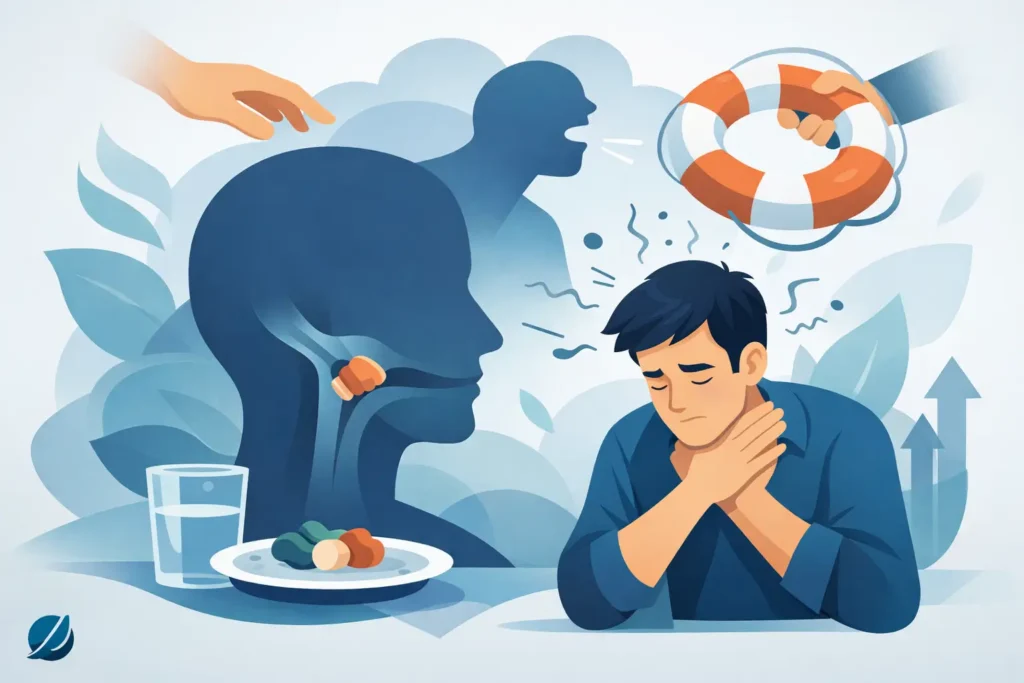
One bad moment with food can change everything. A coughing fit, a tablet that felt stuck, seeing someone else choke, or a panic attack during a meal can be enough to make your brain treat swallowing as dangerous. If you are searching for fear of choking phobia help, you probably already know how quickly this fear can take over daily life.
It often starts small. You begin avoiding certain foods. Then you cut meals into tiny pieces, chew far too long, drink water after every bite, or only eat when someone else is nearby. For some people it gets worse and spreads to tablets, eating out, restaurants, family meals, work lunches, even being alone with food. What looks like “being careful” from the outside can feel exhausting and frightening on the inside.
When eating stops feeling automatic
Most people with this fear know, logically, that they are unlikely to choke. That is what makes it so frustrating. You can understand the facts and still feel panic the second food touches your mouth.
This is why trying to reason your way out of it often does not work. The fear is not being driven by logic. It is being driven by an alarm response. Your mind has paired swallowing with danger, and once that pattern is in place, the body reacts before you get chance to talk yourself down.
That reaction can be intense. Tight throat. Dry mouth. Racing heart. Feeling hyper aware of every chew and swallow. The more you monitor it, the stranger and less natural it feels. Then the panic rises further, which makes swallowing feel even more difficult. That creates a vicious circle.
For some people, the fear of choking becomes so limiting that they lose weight, avoid social situations, dread holidays, and feel embarrassed around family. Parents can become frightened watching a child refuse food. Adults can start planning life around what feels “safe” to eat. It can look irrational from the outside, but to the person living it, the fear feels very real.
Why fear of choking phobia help needs to address the real driver
If you only focus on the food, you miss the real issue. The problem is usually not swallowing itself. The problem is the fear pattern attached to swallowing.
That fear can begin after an actual choking incident, but not always. Sometimes it starts after reflux, a throat infection, a panic attack, health anxiety, trauma, or a period of stress where the body is already on high alert. Once the brain decides that swallowing might be dangerous, it starts scanning for signs of trouble.
That scan changes everything. Normal sensations in the throat feel suspicious. Eating becomes deliberate instead of automatic. You stop trusting your body. Then each “safe” behaviour you use to cope teaches the brain that the danger must be real, otherwise why would you need all those rituals?
This is where many people get stuck. They keep trying to manage the fear while accidentally feeding it. Avoiding certain foods brings short term relief, but it keeps the pattern alive. Reassurance helps for a moment, then the doubt returns. Medical checks can rule out a physical issue, which is useful, but they do not always switch off the alarm response.
That is why proper fear of choking phobia help has to do more than reassure you. It needs to change the way your mind and body are responding.
This is not weakness and it is not attention seeking
People with this fear often judge themselves harshly. They say things like, “I know this sounds silly” or “I should be able to just eat normally.” But this is not about willpower.
When your nervous system has learned that something is dangerous, it will react as if it is protecting you. The problem is that it is protecting you from the wrong thing. That is why force alone does not tend to fix it. You can push through once or twice and still feel terrified the next time.
The better reframe is this: your brain has learned a pattern, and learned patterns can be changed.
That matters, because hopelessness keeps people trapped. They start thinking this is just how life will be now. It is not. I have worked with people whose world became smaller and smaller because of fear, and once the pattern shifts, eating can start to feel normal again. Not managed. Not endured. Normal.
What actually helps with a choking phobia
The right approach depends on what is driving it. If there is a genuine medical swallowing issue, that needs proper medical input. But if you have been checked and told there is no physical reason, then continuing to treat it like a physical problem usually keeps you stuck.
Real progress tends to come from working on the unconscious fear response rather than endlessly analysing it. That means reducing the alarm attached to swallowing, changing the emotional memory linked to the fear, and helping the body stop reacting as if every meal is a threat.
This is where structured change work can make a real difference. Hypnotherapy, mind coaching, EMDR, MEMI and similar approaches can help interrupt the pattern at the level where it is actually running. Not by making you “cope” better, but by helping your system stop firing the same old response.
That does not mean pretending the fear is not there. It means updating it.
For some people, the fear is tied to one clear event. For others, it is built from stress, panic and hyper focus over time. Either way, the goal is the same: remove the false danger signal and rebuild trust in your body.
What change can look like in real life
When this shifts, the first changes are often simple but powerful. Meals feel less tense. You stop thinking about every swallow. Foods you had written off start to feel possible again. You are not bargaining with yourself before every bite.
Then daily life opens back up. Eating out feels easier. Family meals stop being a source of dread. Travelling becomes less of a problem. Tablets may become easier too, if they have been part of the fear. Most importantly, you stop living under the constant question of “what if I choke?”
That freedom matters more than people realise. Fear of choking does not only affect food. It chips away at confidence, spontaneity and quality of life. It can make you feel dependent on routines you do not even like. Once the fear loosens, people often notice they feel calmer in other areas too.
Why quick reassurance is not the same as real change
A lot of advice online tells people to take small bites, eat slowly, relax their shoulders, or practise with soft foods. Those things can help at the edges, especially if panic is making eating harder in the moment. But they are not always enough to solve the pattern.
If your brain still believes swallowing is dangerous, you can become very good at coping while still feeling frightened. That is not the same as being free.
This is the difference between management and change. Management says, “Here is how to get through meals.” Change says, “Let us deal with why meals became threatening in the first place.” If you have already spent months or years trying to manage it, you will know how draining that can be.
A practical, results focused approach is often the missing piece. Not endless talking. Not being told to live with it. Not being handed another tip to get through lunch. Actual work that helps the fear response switch off.
Fear of choking phobia help should give you control back
The aim is not to become dependent on support. The aim is to help you get your life back.
That means understanding what set the pattern up, changing the way your system responds, and helping you return to normal eating without all the fear rituals. It also means being honest about the fact that every case is a bit different. Someone whose fear began after a choking episode may need a different route from someone whose problem started with panic or health anxiety. But different does not mean difficult. It just means the work should fit the person.
If this fear has been running your life, you do not need more theory. You need a way to stop your brain treating food as a threat. That is where focused one to one work can be so effective. When the right pattern is targeted, change can happen far faster than most people expect.
And if you are reading this for someone you care about, the same message applies. Pressure rarely helps. Understanding what is driving it does. This fear is miserable, but it is changeable.
You are not broken. Your body has not forgotten how to swallow. Your mind has learned to be afraid of something that should feel automatic. Once that fear response is updated properly, normal life can start to come back.
Ready to experience real change or keep repeating the same pattern? Book your Real Change Meeting here https://Derekmindcoach.as.me/