
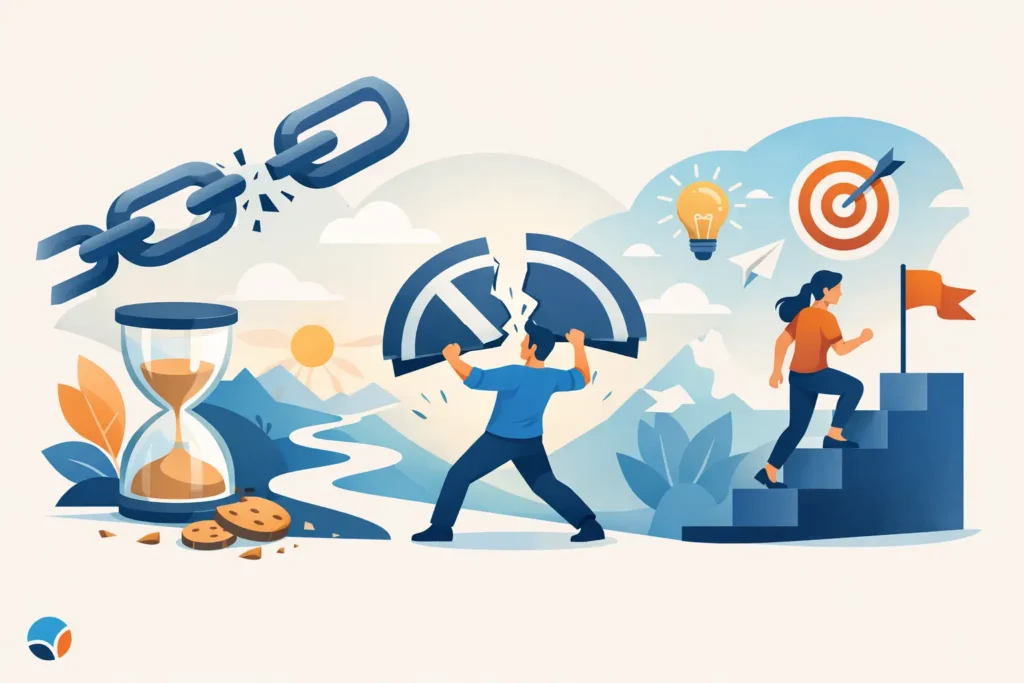
That moment usually comes quietly. You catch yourself doing the same thing again – reaching for a cigarette, picking a fight, scrolling for an hour, snacking when you are not hungry, putting off the task you promised yourself you would do. If you are looking for the best ways to break habits, the first thing to know is this: your habit is not proof that you are weak. It is proof that your brain has learned a pattern well.
That is actually good news, because learned patterns can be changed. Not by shame, and not usually by willpower alone, but by understanding what drives the behaviour and replacing it with something that genuinely works better for you.
Why habits feel so hard to change
Most people try to break a habit at the level of behaviour only. They focus on stopping the thing itself. That can help, but it often fails when the habit is doing a job in the background.
A habit may calm anxiety, create distraction, numb discomfort, provide certainty or fill an emotional gap. Smoking is not always about nicotine. Overeating is not always about hunger. Procrastination is not always laziness. Nail biting, gambling, checking, avoiding, snapping at people, staying up too late – these patterns often have an emotional driver underneath them.
When you try to remove the habit without addressing the reason it exists, you create a battle. Part of you wants change, while another part still needs the relief the habit provides. That is why so many people feel frustrated. They are trying hard, but they are trying at the wrong level.
The best ways to break habits start with the trigger
If you want real change, stop asking only, “How do I stop this?” Start asking, “What happens just before it?”
Every habit has a trigger. Sometimes it is obvious, like having a drink after work or smoking while driving. Sometimes it is more subtle, such as feeling rejected, bored, overwhelmed or not good enough. The trigger may be a place, a person, a time of day or a feeling in your body.
For a week, notice the pattern without trying to be perfect. What time does it happen? What were you feeling? What were you thinking? Who were you with? This is not about judging yourself. It is about collecting the right evidence.
Once you know the trigger, you can interrupt the routine before it gathers momentum. That is where change becomes much more realistic.
1. Make the habit harder and the new behaviour easier
This sounds simple because it is simple, but simple does not mean weak. Habits thrive on convenience.
If your habit is easy, fast and automatic, your brain will keep choosing it, especially when you are tired or stressed. So change the environment. Put barriers in the way of the old behaviour and remove barriers from the new one.
If you mindlessly snack, do not keep trigger foods within easy reach. If you scroll late at night, charge your phone in another room. If you are trying to stop smoking, do not carry cigarettes “just in case”. If you want to go for a walk instead of sitting with anxious thoughts, get your shoes and coat ready before you need them.
Motivation rises and falls. Your environment works all day.
2. Replace the habit, do not just remove it
One of the best ways to break habits is to stop leaving a gap. Nature does not like a vacuum, and neither does your nervous system.
If a habit gives you relief, stimulation or escape, you need a replacement that offers a similar benefit in a healthier way. That does not mean the replacement must be perfect. It just needs to be good enough to begin retraining the pattern.
A person who smokes to settle their nerves may need a fast calming routine they can actually use. Someone who comfort eats in the evening may need a different way to switch off emotionally after a difficult day. A person who procrastinates may need help reducing overwhelm, not another lecture about discipline.
The key is to match the replacement to the need. If the old habit gave you calm, the new one must help you feel calmer. If the old habit gave you escape, the new one must create relief without causing harm.
3. Deal with the emotion underneath
This is where habit change becomes much more powerful. Many stubborn habits are not bad habits at all in the mind’s eyes. They are coping strategies.
That does not mean they are healthy. It means they started for a reason.
If you feel anxious, rejected, trapped or not enough, your brain will look for a fast route out of discomfort. That is why some habits remain in place even when they are damaging your health, confidence or relationships. The habit is solving an immediate emotional problem, even while creating bigger long-term ones.
So ask yourself a better question: what do I feel just before I do this, and what do I get from it straight afterwards?
That answer often reveals the real work. Sometimes it is stress. Sometimes loneliness. Sometimes old trauma. Sometimes a deeply rehearsed belief such as, “I cannot cope unless I do this.” When that deeper issue is addressed, the habit often loses much of its grip.
4. Stop relying on guilt as motivation
Guilt gives people a short burst of urgency, but it rarely creates lasting change. More often, it feeds the cycle.
You do the habit, feel disappointed in yourself, promise to be stricter, then hit stress again and return to the behaviour for relief. Now you feel worse, which makes the habit more likely next time. That loop can go on for years.
Change works better when it comes from self-respect rather than self-attack. That does not mean letting yourself off the hook. It means being honest without being cruel.
A better response sounds like this: “I can see what happened there. I know what triggered it. Next time I will catch it earlier.” That is not a weakness. That is how you build awareness and control.
Best ways to break habits that have been with you for years
Long-standing habits often need more than tips. They become tied to identity, memory and emotion. If you have been repeating the same pattern for years, you may not just be changing behaviour. You may be changing how your mind has learned to protect you.
This is why some people make quick progress on their own, while others stay stuck despite real effort. It depends on how deeply the habit is wired in, what emotional role it plays and whether there is unresolved anxiety, trauma or addiction underneath it.
In those cases, proper support can make a major difference. Approaches such as hypnotherapy, mind coaching and updating the trauma response can help reduce the emotional charge beneath the pattern, so change stops feeling like a daily fight. At Grimsby Hypnotherapy, that is exactly the kind of work we do with people who are tired of repeating those same cycles and want their life back.
5. Make the change smaller than your excuses
People often fail because the plan is too big. They aim for a complete personality overhaul by Monday.
A better strategy is to shrink the action until resistance drops. If your habit is tied to stress, start with 2 minutes of breathing before reacting. If you usually gamble online when you feel low, create one interruption step before you open the app. If you put things off, commit to five minutes, not a perfectly finished job.
Small changes feel almost too basic, but that is the point. Repetition matters more than drama. The brain learns through what you do regularly, not what you attempt once in a burst of frustration.
6. Expect a wobble and plan for it
Relapse thinking ruins progress. People slip once and decide they are back to square one. They are not.
A lapse is information. It shows you where the plan was weak, where the trigger was stronger than expected, or where your emotional reserves were too low. Used properly, it becomes part of the change process.
The most helpful question after a setback is not, “Why am I like this?” It is, “What was missing?”
Perhaps you were exhausted. Perhaps you had not eaten properly. Perhaps you were around a person or place strongly linked to the old pattern. Perhaps you needed support sooner. This is how you refine the plan rather than abandon it.
7.
7. Get support if the habit is linked to anxiety, trauma or addiction
There is a point where trying harder is not the answer. If your habit has become compulsive, if it affects your health or family life, or if it keeps returning no matter how determined you are, support is not a last resort. It is a smart next step.
The right support helps you do more than stop a behaviour. It helps you feel safer in yourself, calmer in your body and more in control of your choices. That matters, because lasting change is rarely about forcing your way through temptation. It is about making the old pattern unnecessary.
For some people, one to one work helps them uncover the root of the habit far faster than they could alone. For others, it is the accountability, structure and emotional reset that changes everything. Either way, you do not need to keep battling the same problem in silence.
Breaking a habit is not about becoming a different person overnight. It is about teaching your mind and body a new response, one repeated choice at a time. Be patient with the process, but serious about the pattern. The life you want is usually on the other side of what you have been tolerating for too long.
Ready to experience real change or keep repeating the same pattern?
Book your Real Change Meeting here