
Here is your cleaned version with reduced punctuation, no hyphens, and tighter flow while keeping your voice intact:
—
It rarely starts with a decision to lose control. More often it begins quietly. A way to switch off, to cope, to fit in, to get through something difficult or to feel something different for a while.
That is why stopping drugs from getting a hold on you matters so much. By the time many people realise there is a problem, the pattern has already started to settle.
If this feels familiar there is no point in shame. Shame keeps people stuck. What works is honesty, early action and the right support before occasional use starts running your moods, your choices and your life.
Why drugs can take hold so quickly
Drugs do not just affect behaviour. They affect relief, routine and emotional survival.
For some the pull is physical. For others it is psychological. Often it is both.
If something reduces anxiety, numbs stress, softens trauma, helps you sleep, boosts confidence or blocks painful thoughts, your mind starts to label it as useful. It stops looking like a risk and starts looking like an answer.
That is where it begins.
The real hook is not always pleasure. It is often relief.
Relief is powerful because it creates the feeling that you need the substance just to feel normal again. Once that link is formed, stopping is no longer about willpower. It is about breaking a learned pattern in the mind and body.
Spot the early signs before it takes hold
You do not need to hit rock bottom. The earlier you act the easier it is to change direction.
One clear warning sign is when use becomes linked to feelings or situations I need something to calm down I need something to switch off I need something to get through this
That is emotional wiring.
Another is secrecy. Minimising it, hiding it, laughing it off or telling yourself you could stop any time while not actually stopping.
Mood changes matter too. Irritability, anxiety, poor sleep, low motivation, feeling flat. Relationships start to feel strained. You become more withdrawn, more defensive, less present.
Even while telling yourself everything is fine.
The mistake of trying to handle it alone
Many people delay getting help because they think they should be able to deal with it themselves.
That is not strength. That is delay.
If the pattern is recent, you might interrupt it alone. But when anxiety, trauma, stress, grief or low confidence are involved, forcing yourself to stop rarely works long term.
Because you are only dealing with the behaviour, not the reason behind it.
If the underlying driver stays in place, the mind will keep looking for another escape.
Lasting change comes from understanding what the drug use is doing for you.
If it helps you avoid panic, numb memories, or feel confident, those issues need resolving properly. Otherwise, you are removing the coping strategy without replacing what it was covering.
What actually works
Start with honesty. Not dramatic, just honest.
Is your use increasing Is it tied to certain emotions Is it affecting your health, work, relationships or how you see yourself
That is your starting point.
Then interrupt the pattern quickly. Change environments. Change routines. Step away from people who keep you in it. Tell one person the truth.
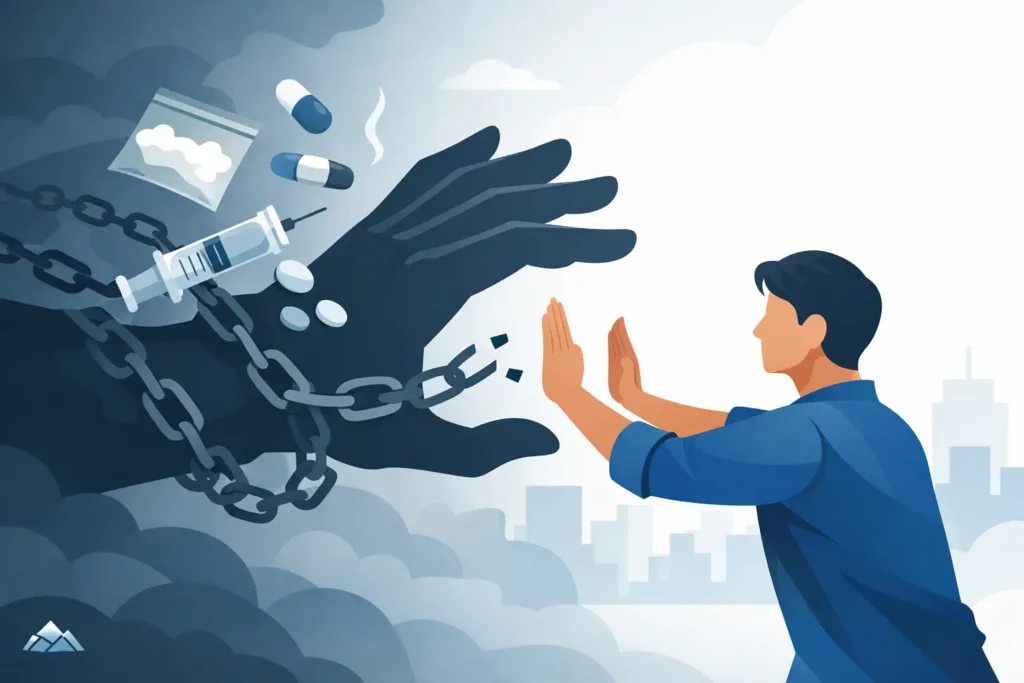
These are not small steps. They are the break in the chain.
Remove the illusion as well. Drugs may give short-term relief but they take more than they give.
More anxiety. Less confidence. Less trust. Less control. Less freedom.
Then replace, not restrict.
If stress is the trigger, learn to regulate it properly If loneliness is the trigger, build a real connection If trauma is underneath, deal with it properly If anxiety is driving it, calm it at the source
That is where real change happens.
Why mindset change is the key
Most people already know the risks. Information is not the problem.
The pattern is.
That is why approaches that work with the mind are so effective. Clinical hypnotherapy, mind coaching and trauma-focused work can reduce the emotional charge behind the habit.
Instead of fighting urges, you remove the reason they exist.
When someone says I do not even know why I keep doing it there is always a reason. It is just not fully conscious yet.
Avoidance. Numbness. Stress. Identity. Habit.
Once that becomes clear, change becomes predictable.
You are not broken. You are patterned. Patterns can be changed.
A confidential first step
The first step is simple and completely confidential. A one to one meeting where you can speak openly without judgement and begin to understand what is really driving the pattern.
You will also see real examples of people who were once in your position and are now completely free. People whose drug use was quietly and sometimes not so quietly ruining their lives and affecting the people around them.
Many clients come in after spending huge amounts trying to fix the problem. Tens of thousands of pounds on the habit itself or on treatment that did not work.
One recent client spent £32000 on rehab and still did not stop.
Now he is clean.
The difference was simple I was doing it for others before, but when I chose to do this for myself, everything changed
This approach is not only far more cost effective than long term rehab, many would say it is more effective because it focuses on changing the pattern, not just managing it.
And it comes back to something simple.
When you like yourself, why would you abuse yourself?
Families matter too
If you are worried about someone else pushing, pleading or policing rarely works.
It creates resistance.
A better approach is calm, clear honesty. Say what you have noticed. Talk about behaviour, mood and reliability. Make it easier for them to be honest, not harder.
At the same time, do not enable it. Support and boundaries can exist together.
Sometimes the most effective thing you can do is stop cushioning the consequences while still offering help to change.
Change can happen faster than you think
People assume this takes years.
Sometimes it does, especially where there is deeper trauma.
But often change starts quickly when the right lever is pulled.
When someone understands their triggers, breaks the routine, changes the meaning attached to the substance and addresses the root cause, momentum builds fast.
This is not guesswork. It is what happens when you target the pattern, not just the behaviour.
At Grimsby Hypnotherapy, that is the focus. Changing patterns at the level they were formed so you can take back control of your thoughts, your choices and your future.
You are not your habit
This matters.
Using drugs, struggling with drugs or feeling pulled towards them does not make you weak or beyond help. It means something in your life has found an unhealthy solution to a real problem.
That solution can be changed.
Your confidence can return Your calm can return Your self-respect can return
It starts with one honest moment where you stop pretending it is fine and decide it is time to change.
If that moment is now, act on it.
Take that step today, not someday https://tr.ee/v4AIrq
That voice is not there to criticise you. It is there to lead you back to yourself.