
Most people with a fear of flying are not scared of the plane itself. They are scared of what they imagine might happen once the door closes and control feels out of their hands.
That is why a fear of flying often feels bigger than logic. You can know statistically that flying is safe and still feel your chest tighten at the airport. You can tell yourself to stay calm and still picture turbulence, panic, embarrassment or being trapped. This is exactly where hypnotherapy can help, because the problem is not usually a lack of information. It is the way your mind has learned to link flying with danger.
What a fear of flying hypnosis example actually shows
When people search for a fear of flying hypnosis example, they are usually trying to answer one question: what actually happens in a session, and will it feel safe?
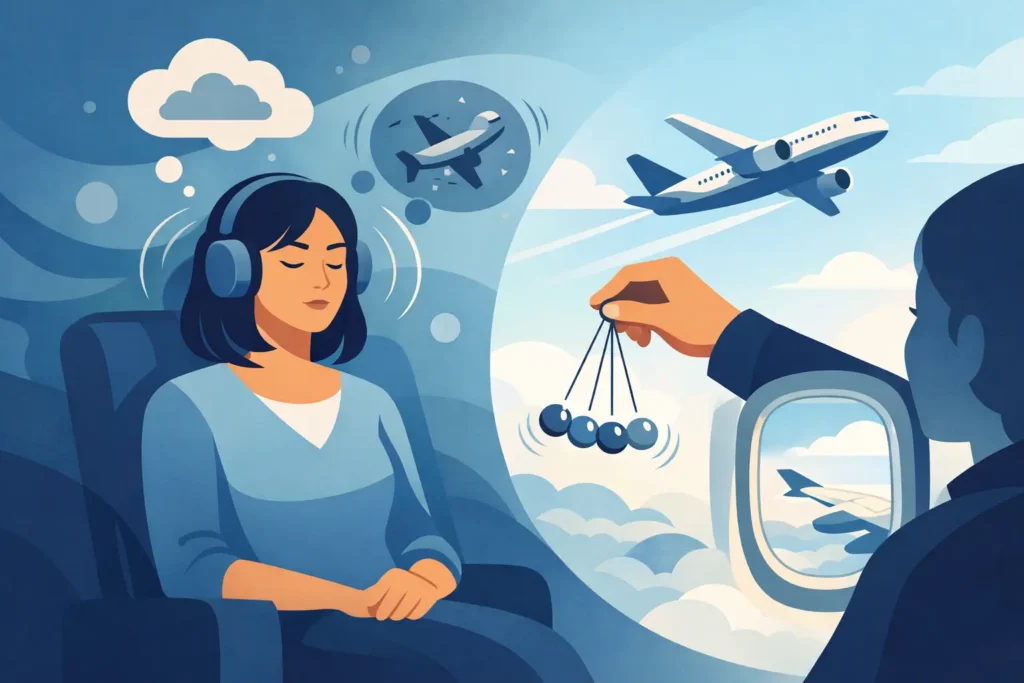
A good example is not stage hypnosis. You do not lose control, reveal secrets or get made to do anything against your will. Clinical hypnotherapy is a guided process that helps you relax, focus and respond differently to thoughts, sensations and triggers that used to set off fear.
In simple terms, hypnosis helps quieten the part of the mind that keeps running the same anxious loop. Once that loop softens, it becomes easier to introduce new associations – calm, safety, confidence and control.
For someone who dreads flying, that change can be powerful. Instead of mentally rehearsing disaster from the moment a trip is booked, they begin to experience the journey in a different way. The airport feels manageable. Boarding feels possible. Turbulence no longer means immediate panic.
A realistic fear of flying hypnosis example
Here is a simple example of the kind of hypnotic language that might be used during a session. This is not a full treatment script, because proper hypnotherapy is tailored to the person, their history and the reasons behind their fear. Still, it gives you a feel for how the process works.
You are invited to sit comfortably and focus on your breathing. Nothing forced. Nothing strange. Just a chance to allow your mind and body to settle.
“As you breathe slowly and easily, you may begin to notice that you do not need to fight every thought that comes into your mind. You can let thoughts pass. You can let your shoulders soften. You can allow that feeling of safety to grow, little by little.
And as your body relaxes, your mind can begin to picture a journey in a different way. Not the old fearful version. A new version. One where you arrive at the airport feeling steady. One where each step is simple and calm. Checking in. Walking through the terminal. Hearing the sounds around you and remaining comfortable.
You might imagine taking your seat on the aircraft and noticing that you can breathe normally. You can sit back. You can let the seat support you. You can recognise that every sound, every movement, every part of the journey is ordinary and expected.
And if the plane begins to move, your mind can remember this: movement does not mean danger. Sensation does not mean fear. A change in sound does not mean something is wrong. Your body can stay calm because you are safe.
You can imagine the aircraft rising smoothly, and with every breath, confidence grows. Calm becomes more familiar. Your mind begins to trust what is happening. You are not trapped. You are travelling. You are capable. You are in control of your response.
And from this point on, each time you think about flying, you can feel more settled, more prepared and more certain that you can handle it.”
That style of language works because it does three things at once. It relaxes the nervous system, interrupts the old fear pattern and installs a calmer mental rehearsal of the flight experience.
Why this helps more than positive thinking
Many people have already tried talking themselves out of the fear. They have read facts about aviation safety, watched videos and told themselves to stop being silly. Yet the body still reacts.
That happens because fear of flying is often stored as an automatic response. The trigger might be take-off, turbulence, enclosed spaces, loss of control, fear of panic, or even a bad memory linked to travel. Once the brain labels flying as a threat, it can fire off anxiety before you have had a chance to think rationally.
Hypnotherapy works below that surface level. It does not just argue with fear. It helps retrain the response.
That said, not every fear of flying is identical. For one person, the issue is claustrophobia. For another, it is health anxiety. For someone else, it is the fear of having a panic attack in public and not being able to escape. This is why a generic recording can help some people, but one-to-one support often goes further. The real progress comes from understanding what your mind is actually reacting to.
What happens in a proper session
A professional session should never begin with someone simply reading a script at you. First, there needs to be a conversation.
That means exploring when the fear started, what exactly happens before and during a flight, what thoughts run through your mind and what your body does under stress. It also means looking at whether the fear of flying is the main issue, or whether it is part of a wider anxiety pattern.
From there, the work becomes much more focused. Hypnosis may be used alongside practical mind coaching, reframing techniques and tools to help you feel more in control before you even get on a plane.
Sometimes the goal is to remove the fear entirely. Sometimes the first goal is more modest and more realistic – to help you get through an upcoming flight without panic. Both matter. Lasting change often happens in stages.
What fear of flying hypnosis feels like
One reason people delay getting help is that they are nervous about hypnosis itself. That is understandable, especially if their only reference point is television.
In reality, most people describe hypnosis as deeply relaxing but very normal. You are aware of what is being said. You can hear everything. You are not asleep, and you are not unconscious. You are simply in a more focused, receptive state.
Some people feel physically heavy. Others feel light and calm. Some notice their breathing slow down. Some drift in and out of vivid imagination. There is no single correct experience. The important part is not how dramatic it feels. The important part is whether your mind starts learning a new response.
Can one fear of flying hypnosis example fix the problem?
Sometimes a single session or recording gives a surprising amount of relief. If the fear is mild, or linked to a specific upcoming flight, that can be enough to shift things.
But if the fear has been there for years, if you avoid holidays, cancel trips, lose sleep before travel or feel ashamed of how strongly you react, it usually deserves more than a one-off script. Long-standing fears often have roots. They may connect to earlier panic episodes, childhood experiences, health worries or a broader need to stay in control.
That is not bad news. It simply means effective help should be personal, not rushed.
This is where working with an experienced practitioner can make the difference. At Derek Chapman Hypnotherapy, the focus is not just on temporary relaxation. It is on helping people change the deeper pattern so they can travel, live and breathe more freely.
The real aim is not to love flying
People often think success means becoming someone who adores airports, looks forward to turbulence and grins through take-off. That is not necessary.
The real aim is freedom. Freedom to book the trip. Freedom to visit family. Freedom to go on holiday without weeks of dread. Freedom to sit on a plane and feel calm enough that flying becomes just another part of life, not a private battle nobody else sees.
You do not need to force confidence. Confidence usually grows after the fear starts loosening its grip.
If reading a fear of flying hypnosis example has helped you see that this process is calmer and more practical than you expected, that matters. Change often begins the moment you realise your fear is not who you are – it is just a pattern, and patterns can be changed.