
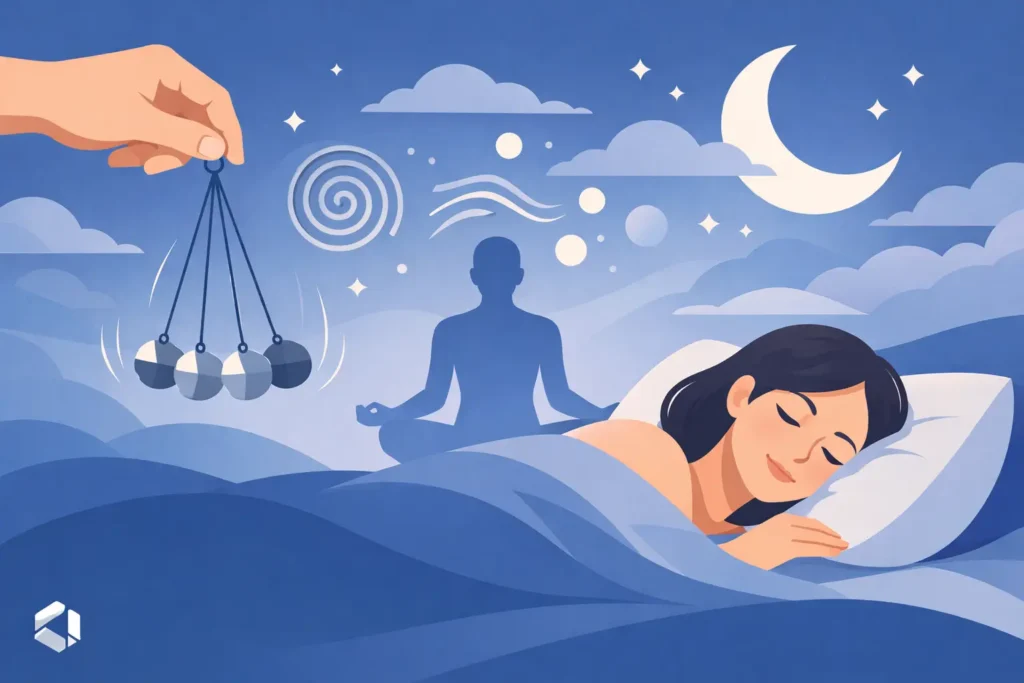
If your body is tired but your mind is still holding a meeting at 1am, you are not the only one. A lot of people look into sleep hypnosis techniques when they are fed up with lying there, clock watching, overthinking and waking up already drained.
The problem is not always sleep itself. Often, sleep is the point where the real pattern shows up. Daytime stress, anxiety, old habits, a mind that stays on high alert, or the pressure to sleep can all keep the system switched on. Then bedtime becomes a performance. And the more you want sleep, the more wide awake you feel. Funny that, isn’t it.
What sleep hypnosis techniques are really doing
Sleep hypnosis techniques are not about being knocked out or controlled. They are ways of helping the mind and body shift out of tension and into a calmer state where sleep has a chance to happen.
That matters because you cannot force sleep in the same way you cannot force yourself to relax by shouting at yourself internally. The more pressure you add, the more alert you become. Good hypnosis based methods reduce that pressure. They interrupt the pattern of effort, fear and frustration that often builds around bedtime.
For some people, the issue is a busy mind. For others, it is physical tension, dread about the next day, or the habit of scanning for signs that they are still awake. Thoughts are not facts, but at 2am they can feel very convincing. One anxious thought turns into ten. Then the body responds as if there is a problem to solve.
Fear is often an illusion, a story the mind creates to keep us safe. At night, that story can sound like this: if I do not sleep, tomorrow will be a disaster. Once that pattern is running, the bed starts to feel like a battleground instead of a place to rest.
The most useful sleep hypnosis techniques for bedtime
Some sleep hypnosis techniques are simple and practical. That is often why they work. They give your attention somewhere better to go.
Progressive relaxation
This is one of the most effective starting points. You slowly relax the body, usually from head to toe or toe to head, and allow each area to soften. The point is not to do it perfectly. The point is to stop gripping.
When people cannot sleep, they are often tense without realising it. Jaw tight. Shoulders lifted. Stomach braced. Progressive relaxation helps break that pattern. It gives the body a clear message that the day is over.
A simple version sounds like this in your own head: relax the forehead, loosen the jaw, drop the shoulders, soften the hands, unclench the stomach, release the legs. Slow and steady. Nothing fancy.
Guided imagery
This works well for people whose minds race the second the room goes quiet. Guided imagery gives the mind a calmer track to follow. You might picture a quiet beach, a peaceful garden or somewhere that feels safe and still.
The key is detail. What can you hear? What is the temperature like? What colours do you notice? The more gently absorbed you become in the scene, the less attention goes into sleep anxiety.
It is not about pretending life is perfect. It is about giving the mind a better job than worry.
Repetition and suggestion
Simple repeated phrases can help settle the mind, especially when they remove effort. Phrases such as I can rest now, I am safe enough to let go, or my body knows how to sleep can be useful.
That said, this depends on the person. If a phrase feels fake or forced, it can be irritating. Better to use words that feel believable. The mind responds better to calm truth than grand statements it does not buy.
Breathing with focus
Slow breathing on its own is useful, but adding attention makes it more hypnotic. Count the breath in for four, out for six, and follow the sensation of the air moving. Or imagine each out breath carrying tension away.
Longer out breaths tend to help the body settle. Not because there is magic in the counting, but because it gives rhythm, focus and a sense of slowing down.
Why some techniques work for one person and not another
This is where people often get frustrated. They say they have listened to recordings, used apps, done breathing exercises and still feel stuck. That does happen.
The reason is simple. The issue is not always the real issue.
If your sleep problem is being driven by health anxiety, unresolved stress, panic at night, fear of losing control, or a learned pattern of hyper alertness, then a generic sleep track may only scratch the surface. It may relax you a bit, but not change the pattern keeping the warning light on.
Anxiety can be like a warning light. The warning light is not always the real problem. If the underlying pattern stays the same, the mind can keep switching itself back on, even when you are exhausted.
That is why some people do well with self help methods and others need something more personal. Not because they are broken. They are not broken. They have learned a pattern, and what has been learned can be changed.
How to use sleep hypnosis techniques properly
The biggest mistake is only using them when you are already frustrated. If you wait until you are annoyed, tense and clock watching, you are asking a calm technique to compete with a full blown stress response.
It works better to use sleep hypnosis techniques as part of a wind down routine before you hit the point of panic or irritation. That might mean switching off screens earlier, dimming the lights, listening to a guided session while still calm enough to follow it, and stopping the habit of checking the time.
Another mistake is judging every session. People often think, this is not working, I am still awake. But the first job is not always instant sleep. Sometimes the first shift is reducing tension, lowering panic, or ending the battle with being awake. That matters more than most people realise.
Also, avoid turning the technique into another test. If you lie there thinking, right, this had better work tonight, you have quietly turned relaxation into pressure again.
When recordings help and when a personal approach helps more
Recordings can be useful, especially if the problem is fairly mild or recent. They can help create a routine and train the mind to slow down at a certain time. For some people, that is enough.
But if poor sleep is tied into anxiety, trauma, panic, grief, addiction, or years of overthinking, a recording may not be enough on its own. In those cases, the person often does not need more sleep tips. They need the pattern behind the sleep problem to change.
That is where one to one work can make more sense. A tailored approach can get to what is actually keeping the system on alert, rather than endlessly managing the symptom at night.
For clients working with a practitioner, sleep often improves as the deeper issue improves. That might be anxiety, fear, inner tension, or an old learned response that no longer serves them. Again, the issue is not always the real issue.
Sleep hypnosis techniques and bedtime anxiety
Bedtime anxiety is common, and it can be sneaky. Some people feel calm all day then tense up the second they get into bed. Others dread not sleeping before the night has even started.
This is where sleep hypnosis techniques can be especially useful, because they break the link between bed and stress. They help replace anticipation with calm repetition. Over time, the mind starts learning a different response.
That said, if you are using the bed as an office, cinema, argument chamber and worry station, the mind gets mixed messages. Your environment matters. Your routine matters. Your inner dialogue matters too.
If your last thought every night is here we go again, the body hears that as a cue.
A better angle is gentler and more honest. Something like, I do not need to force this. Rest is still useful. My body can settle. That takes the fight out of it.
A realistic way to think about results
Some people notice a change quickly. Others need repetition. It depends on how long the pattern has been there, what is driving it, and whether the technique fits the real problem.
The goal is not perfection. It is not never waking in the night again, or falling asleep in thirty seconds like a light switch. The real win is changing the relationship with bedtime so your system no longer treats it like a threat.
When that happens, sleep usually starts to feel more natural again. Less effort. Less drama. Less lying there negotiating with your own mind.
If sleep has become a nightly struggle, keep this in mind. You do not need more pressure. You need the pattern to change, and that starts by calming the fight rather than feeding it.