
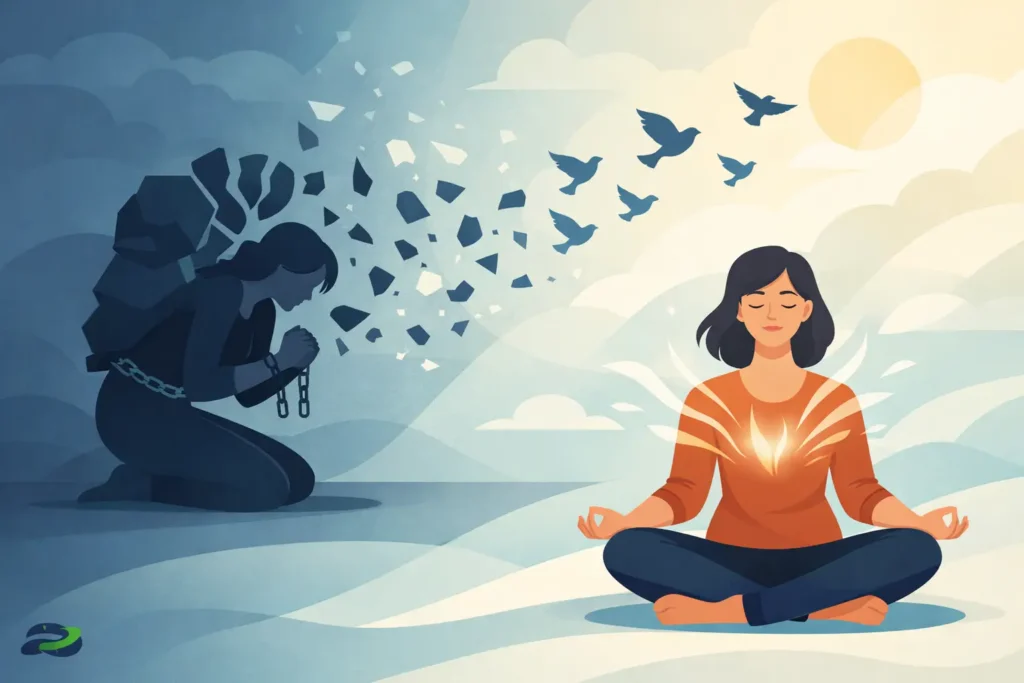
You can know you are safe and still feel your chest tighten, your stomach drop, or your whole body brace as if something bad is about to happen. That is why so many people search for how to release trauma responses. They are not being dramatic. They are tired of reacting to life as if every moment carries a threat.
For some people it shows up as panic, overthinking, snapping at people they love, shutting down, people pleasing, poor sleep, or feeling on edge for no clear reason. For others it looks like habits they cannot shift, even when they are desperate to stop. Drinking too much, gambling, avoiding situations, checking everything, staying busy all the time, or pulling away from relationships can all be part of the same pattern.
The frustrating part is this. Most people have already tried to talk themselves out of it. They have told themselves to calm down, to move on, to be rational, to stop overreacting. It rarely works for long, because trauma responses are not a sign of weakness or lack of intelligence. They are learned survival patterns.
What trauma responses actually are
A trauma response is your system doing its best to protect you based on what it learned before. If your mind and body have linked certain feelings, situations, sounds, memories, or even times of day with danger, they can react before you have time to think.
That reaction might be fight, flight, freeze, or fawn. You may become angry fast, feel the urge to escape, go blank, or automatically try to keep everyone else happy so you stay safe. None of that means there is something wrong with you. It means your system adapted.
The problem comes when the old pattern keeps firing in situations that are no longer dangerous. Then you are not responding to what is happening now. You are responding to what your system expects might happen.
That is why people often say, “I know it makes no sense, but I still feel it.” They are right. On a logical level, it may make no sense at all. On an unconscious level, it makes perfect sense.
Why trauma responses keep coming back
If you want to know how to release trauma responses, it helps to understand why they stick around. The short answer is that insight alone is usually not enough.
You can understand your past and still feel trapped by it. You can know where a pattern started and still keep repeating it. That is because many trauma responses sit below conscious thought. They are automatic. They are fast. They are designed to bypass debate.
This is also why coping strategies can feel hit and miss. Breathing exercises, mindfulness, distraction, going for a walk, and talking things through can all be useful. They can reduce the intensity in the moment. But if the underlying response has not been updated, the same trigger often returns you to the same state.
That does not mean those tools are useless. It means they are not always the full answer.
How to release trauma responses without forcing it
A lot of people try to release trauma responses by pushing through, avoiding triggers, or endlessly analysing the past. None of those approaches consistently create change.
Pushing through can make you feel stronger in the short term, but if your body still believes there is danger, you are often just overriding the alarm rather than switching it off. Avoidance gives temporary relief, but it also teaches the system that the trigger really was too much to handle. Endless analysis can keep you stuck in the story instead of changing the response.
Real change usually happens when the mind and body no longer need the old pattern. That means working at the level where the response was learned, not just where you talk about it.
This is why approaches focused on unconscious change can be so effective. You do not always need years of discussion or repeated retelling of painful events. In many cases, trauma can be updated without going over every detail of the past. What matters is changing the meaning and the reaction attached to it.
Stop asking, “Why am I like this?”
That question keeps a lot of people stuck.
It sounds reasonable, but it often carries shame. It turns a learned response into a character flaw. A better question is, “What is my system trying to protect me from?” That small shift changes everything.
When you stop treating your symptoms like the enemy, you can start changing them properly. Anxiety, numbness, anger, compulsions, and avoidance are often attempts at protection. They may be outdated, disruptive, and exhausting, but they were created for a reason.
Once that reason is understood and updated, the pattern can lose its grip.
What actually helps release trauma responses
The right approach depends on the person. Someone with a clear single event may need something different from someone who has had years of stress, criticism, instability, or emotional pain. Some people are dealing with obvious trauma. Others would never use that word, but their system is still reacting as if danger is close.
What tends to help is work that is structured, focused, and practical. Not more coping for the sake of coping. Not endless weekly sessions with no sense of progress. Real change comes when the response itself is targeted.
That can involve methods such as EMDR, hypnotherapy, mind coaching, MEMI, and other approaches designed to update the unconscious pattern behind the reaction. The key is not the label on the technique. The key is whether it helps your system stop treating the present like the past.
When that happens, people often notice changes quickly. The trigger is still there, but the old surge is gone. They can think clearly. Their body settles. Their choices feel easier. They no longer have to manage themselves every minute of the day.
Signs your trauma response is changing
The change is often quieter than people expect.
It might look like sleeping through the night without that jolt awake. It might be driving somewhere that used to feel impossible and realising halfway through that you are calm. It might be hearing a tone of voice that used to set you off and noticing that nothing inside you spikes. It might be finally saying no without guilt or walking away from a habit that used to feel stronger than you.
These are not small wins. They are signs your system is learning safety.
Some people expect healing to feel dramatic. Sometimes it does. More often, it feels like space. More calm. More choice. Less effort.
What not to do when you want relief
Do not assume that because a response is old, it has to be permanent. That belief keeps many people trapped for years.
Do not measure progress only by whether you never feel triggered again. Being human means you will still have emotions, stress, and difficult days. The difference is that your reactions no longer run your life.
And do not think you have failed if talking about it has not helped enough. For many people, insight is only one piece of the puzzle. If the unconscious pattern has not shifted, the symptoms can keep returning no matter how much you understand them.
The real goal is not coping forever
This matters. Too many people have been taught to lower their expectations and settle for managing symptoms. Sometimes short term management is necessary, especially if life feels overwhelming. But long term, most people do not want a better way to live around the problem. They want the problem to stop controlling them.
That is a fair goal.
If your reactions have been running on autopilot, the answer is not to blame yourself or keep fighting your own mind. The answer is to change the pattern at the level it lives.
That is where real relief comes from. Not from pretending it is fine. Not from rehearsing the pain forever. From updating the response so your system no longer acts as if old danger is still present.
If you have been stuck in the same cycle for months or years, that does not mean you are broken. It usually means the right part of the problem has not been addressed yet. When it is, things can shift far faster than people expect.
You do not need to spend the rest of your life bracing, avoiding, overthinking, or trying to control every feeling. You can feel like yourself again, and for many people that starts the moment they stop asking how to survive the pattern and start changing it.
Ready to experience real change or keep repeating the same pattern? Book your Real Change Meeting here https://Derekmindcoach.as.me/