
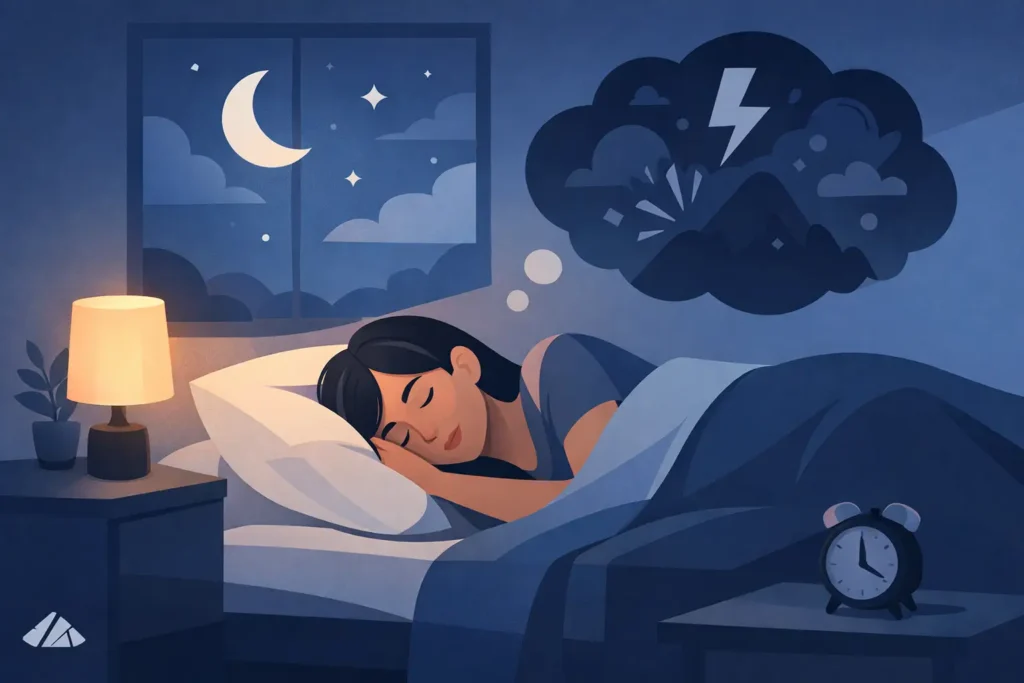
The house is quiet.
Your body is tired.
Yet the moment your head hits the pillow, your mind starts work.
That conversation from earlier. Tomorrow’s list. Money. Your health. Something you said three years ago that suddenly feels urgent at 1.17am.
If you are wondering how to calm bedtime anxiety, you are not weak and you are not broken. You are caught in a pattern.
And patterns can change.
The problem is that most people make bedtime anxiety into a bigger fight than it needs to be. They lie there demanding sleep. They check the clock. They get angry with themselves. Then sleep becomes another thing they have failed at.
That is not calm.
That is pressure.
Why bedtime anxiety feels worse at night
During the day, there is noise. Work. People. Jobs to do. Even when anxiety is present, you can often keep moving.
At night, the distractions stop.
Your mind finally has room to bring up everything it has been storing. Not because it wants to ruin your sleep. Because it has learned that the quiet of bedtime is the moment to scan for problems.
It is a protection pattern. A very unhelpful one, but a pattern all the same.
Your body may feel tense. Your chest may feel tight. Thoughts jump from one worst-case scenario to the next. You may even start fearing bedtime itself because you expect another long night.
That expectation matters.
Once your mind links bed with fear, frustration and endless thinking, getting into bed can switch the whole pattern on before you have even turned the light off.
The answer is not forcing yourself to sleep.
You cannot bully your way into calm.
Stop making sleep the job
Sleep is something your body does when it no longer believes it needs to stay alert.
The more you watch for sleep, chase sleep or measure how many hours are left, the more alert you become. You are telling your system that this is important. Important things need attention. Attention keeps you awake.
So change the job.
Your job is not to sleep.
Your job is to rest.
Lie down with the aim of letting your body be still, rather than demanding eight perfect hours. If sleep comes, good. If it does not come immediately, you are still giving your body a break from the day.
This sounds simple because it is simple. That does not mean it is insignificant.
When you take the demand away, the pressure starts to drop. And when pressure drops, sleep has a chance to return naturally.
Give anxious thoughts a place to go before bed
A racing mind usually has one concern underneath it: “If I stop thinking about this, I will lose control.”
But repeating the same thought at midnight is not problem-solving. It is mental pacing.
Set aside ten minutes earlier in the evening. Write down what is bothering you in plain language. Next to each concern, write one of two things: what you can do tomorrow, or what is outside your control tonight.
Keep it basic.
“Call the garage tomorrow.”
“Check my bank balance at 9am.”
“Nothing I can do about that conversation now.”
Then when the thought arrives in bed, you do not need to argue with it. Say, quietly, “That is written down. It has a place. Not now.”
You may need to say it ten times. Fine.
You are not doing it to make the thought vanish. You are teaching your mind that bedtime is no longer the place for emergency meetings.
Use your body to send a different message
Anxiety is not only thinking. It is physical.
If your shoulders are up around your ears, your jaw is clenched and your breathing is shallow, your body is sending a very clear message: stay ready.
Start there.
Let your tongue rest away from the roof of your mouth. Unclench your jaw. Drop your shoulders. Feel the weight of your legs against the mattress.
Then make your out-breath a little longer than your in-breath. Not huge breaths. No forcing. Just a steady inhale, then a slower, softer exhale.
Count four in and six out if counting helps. If it does not, simply focus on the feeling of the breath leaving your body.
A longer out-breath is a physical signal that the danger has passed.
You are not pretending everything is fine. You are reminding your body that lying in a dark room is not an emergency.
Be careful what you practise at 2am
This is where people get caught.
They wake up anxious, grab their mobile phone, check the time, search symptoms, read upsetting news or scroll through other people’s lives. Then they wonder why they feel more awake.
Your mobile phone is not calming you. It is giving your anxious mind more material.
If you wake in the night, keep the lights low. Do not check the clock if you can avoid it. The exact time rarely helps. It usually starts the maths: “If I fall asleep now, I will only get four hours.”
That thought creates urgency.
Urgency creates anxiety.
If you have been awake for a while and frustration is building, get out of bed. Sit somewhere dim and do something boring and quiet until you feel sleepy again. A few pages of an ordinary book can do more for you than another hour of wrestling with the pillow.
You are breaking the link between bed and battle.
Look at the habits that keep the pattern going
Bedtime anxiety is often fed long before bedtime.
Caffeine late in the day can leave the body on edge. Alcohol may make you drowsy at first but can disrupt sleep later. Working, worrying or watching intense television right up until bed gives your mind no clear line between the day and the night.
This does not mean you need a perfect evening routine with candles, expensive gadgets and a colour-coded sleep chart.
You do not.
It means creating a clearer finish to your day.
Put work away. Dim the lights. Have the same rough bedtime most nights. Give yourself a short gap between doing and sleeping.
Consistency beats perfection.
One late night does not ruin anything. One bad night does not mean you are back at square one. The fear people attach to a poor night’s sleep is often more damaging than the poor sleep itself.
When bedtime anxiety is about more than bedtime
Sometimes sleep is the surface problem.
You may be exhausted because your mind never really switches off in the day either. You may carry old fear, pressure, grief or experiences that taught you the world is not predictable. Your system stays on guard because it believes that is its job.
What if the problem is not the problem?
What if your sleep is not broken, but your mind has learned a pattern of staying alert?
That is why sleeping tablets, routines and distraction can help for a while but may not change the reason the pattern keeps returning. They manage the symptom. They do not always update what is driving it.
Real change comes when the emotional meaning changes.
You do not have to spend years going over every detail of the past to do that. You do need to be honest about the pattern, understand what is keeping it alive, and be ready to make a different choice.
For some people, that work is best done with a professional who can help them get to the real issue without turning every meeting into a replay of what happened. Hypnotherapy and mind coaching can be useful here because the focus is practical: change the fear, change the belief, change the response.
Based in Grimsby, I work with people across Lincolnshire and worldwide on Zoom who are tired of managing anxiety and ready to feel in control again.
How to calm bedtime anxiety when it hits tonight
Keep this simple.
Do not demand sleep.
Rest your body.
Slow the out-breath.
Do not check the clock.
Tell yourself the thought is noted and can wait until tomorrow.
And if you are wide awake and getting annoyed, leave the bed for a short while instead of turning it into a battleground.
These steps will not make every night perfect. That is not the point. They begin to remove the fear and pressure that feed the pattern.
You do not need to win a fight with sleep.
You need to stop treating bedtime like one.