
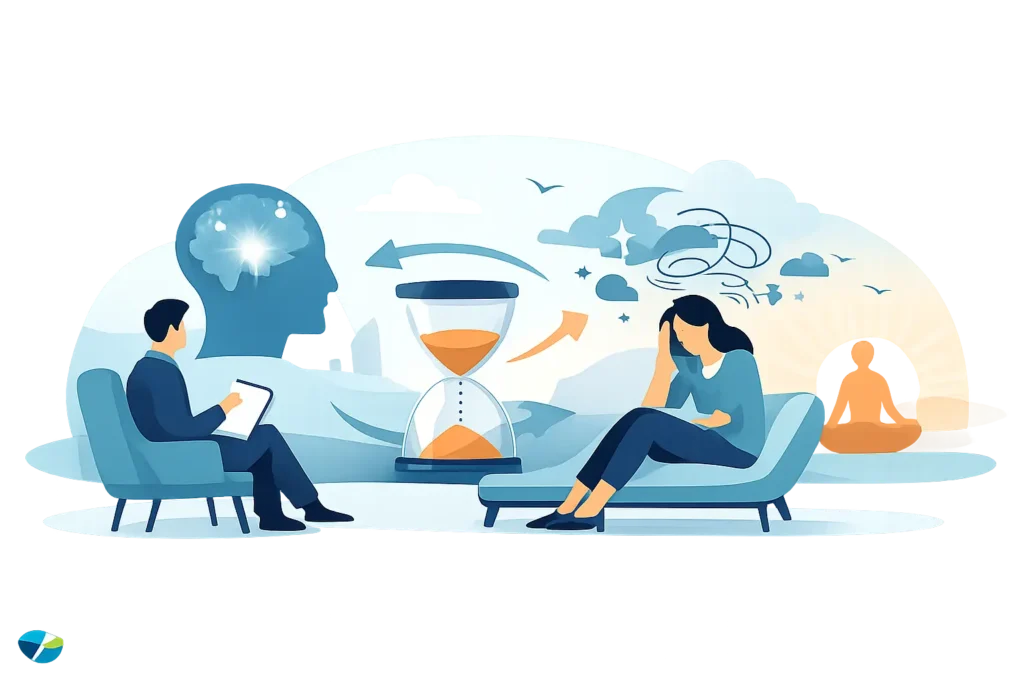
That feeling can hit in seconds. Tight chest. Racing thoughts. A knot in your stomach before work, before sleep, before leaving the house, or sometimes for no obvious reason at all. If you are looking for a guide to rapid anxiety treatment, you probably do not want a long lesson on stress. You want to know why this keeps happening and what can actually change it.
The hard part with anxiety is not just the feeling itself. It is what starts to happen around it. You begin avoiding things. You second guess yourself. You scan your body. You try to control every situation so nothing sets you off. After a while, life gets smaller and anxiety gets louder.
That is why quick relief matters. Not because you want a magic trick, but because when anxiety has taken over your thinking, sleep, confidence or routine, you need something that works at the level where the pattern is actually running. Coping tools can help in the moment. Real change comes when the deeper response is updated.
What rapid anxiety treatment really means
A good guide to rapid anxiety treatment should clear up one thing straight away. Rapid does not mean rushed. It does not mean pretending the problem is minor or trying to talk you out of how you feel. It means getting to the root of the anxious response without spending months circling around it.
For some people, anxiety is linked to a clear event. For others, it is built from years of pressure, fear, overthinking or learned responses that have become automatic. Either way, the pattern tends to run fast and below conscious awareness. You can know you are safe and still feel panicked. You can know a thought is irrational and still react as if it is true.
This is why people often get frustrated. They have insight, but no shift. They understand the problem, but still live with it. Anxiety is not always a knowledge problem. Very often, it is a pattern problem.
Why anxiety can feel stronger than logic
Most anxious people are not weak. They are often highly aware, capable and used to pushing through. The trouble is that anxiety does not care how sensible you are when your system has learned to treat something as a threat.
That threat might be obvious, like driving, public speaking or sleeping alone. It might be more hidden, like fear of losing control, fear of embarrassment, fear of failing, or fear of the feeling of anxiety itself. Once the mind and body start pairing ordinary situations with danger, the response becomes automatic.
You then get a loop. Something triggers the response. Your body reacts. You notice the reaction and get worried about it. That extra fear makes the symptoms worse. Soon the anxiety is feeding itself.
This is why many people say, “I do not even know why I feel like this.” They are not making it up. The conscious mind is often the last part to catch up.
The problem with managing it forever
There is nothing wrong with using breathing exercises, grounding, exercise, better sleep, or cutting down caffeine. These can all help. But they are not always enough.
If your whole life is becoming a routine of managing anxiety, there is a bigger question to ask. Why is the pattern still there?
A lot of people have tried medication, counselling, self help books, podcasts and endless advice from friends. Some get a bit of relief. Some feel understood. But many are still stuck with the same triggers, the same dread, and the same fear that this is now just who they are.
It is not.
That is the reframe many people need. Anxiety may feel part of your identity because it has been around so long. But it is still a pattern. And patterns can change.
A better guide to rapid anxiety treatment starts with the right target
If you aim treatment at symptoms alone, progress can be slow. If you aim it at what is driving the response, things can move much faster.
That means looking at what your mind has learned to do automatically. It means identifying the emotional charge behind the trigger, the old response that still fires in the present, or the inner belief that keeps reinforcing the fear. In practice, this is often where fast change happens.
For one person, the real issue may be unresolved shock from a past event. For another, it may be a long standing fear of being judged. For someone else, it may be a nervous system that has got stuck in high alert after years of stress. The symptom might look similar on the surface, but the driver underneath can be very different.
That is also why generic advice can fall flat. It helps some people and misses others completely. Effective treatment needs to be focused, personal and direct.
What tends to work best when speed matters
When someone wants relief quickly, the most useful approach is one that does not rely on talking about the same problem week after week. It needs to do more than analyse. It needs to create change.
That is where methods focused on unconscious change can be so effective. Approaches such as hypnotherapy, mind coaching, EMDR and similar change based work are designed to update the way the mind responds, rather than just helping you cope with the fallout.
This matters because anxiety often keeps going even when you are doing your best. You are trying to stay calm on the surface while a deeper part of you is still reacting as if danger is close. Once that deeper response is changed, the struggle often drops away far more quickly.
In real terms, that can mean walking into situations that used to trigger you and noticing the old reaction simply is not there in the same way. It can mean sleeping better because your system is no longer braced. It can mean feeling more like yourself again instead of constantly monitoring how you feel.
Rapid does not mean the same for everyone
Some people respond very quickly. Others need a little more work, especially if anxiety is tied into trauma, addiction, sleep issues or long standing habits. The honest answer is that it depends.
But there is a big difference between work that feels focused and work that feels endless. If you know what you are targeting, if the process is structured, and if the aim is change rather than dependency, progress is usually clearer.
That is especially important for people who have already “done the work” and still feel trapped. They do not need more theory. They need a process that gets underneath the pattern and shifts it properly.
What to look for in anxiety treatment
If you are choosing support, look for someone who is clear, direct and not vague about outcomes. You want a process that feels practical, not endless. You want to know that the aim is to help you take control, not keep you coming back forever.
You also want someone who understands that not everybody wants to sit and relive the past. For many people, especially those carrying trauma, the idea of talking through old events in detail can put them off getting help at all. Good change work does not always require that.
The best treatment should leave you feeling more capable, not more fragile. It should help you understand what is happening without making anxiety the centre of your identity.
The real shift people are looking for
Most people are not asking for perfection. They are asking for peace. They want to go to work without dread. They want to drive, travel, sleep, socialise, parent, focus and enjoy normal things without their mind constantly preparing for disaster.
They want to stop avoiding. Stop overthinking. Stop living as if something bad is always about to happen.
That is what makes rapid anxiety treatment worth talking about. Not because fast sounds impressive, but because when the right part of the problem is treated, change can happen much sooner than people have been led to believe.
You do not have to keep measuring your life around anxiety. You do not have to keep building routines around fear and calling it normal. If the pattern was learned, it can be unlearned. If the mind has been conditioned into alarm, it can be updated.
And once that happens, confidence tends to return naturally. Not forced. Not faked. Just there, because the thing that kept knocking you off balance is no longer running the show.
If you have been stuck for a while, take that seriously. Not as proof you are broken, but as a sign that the right kind of help matters. There is a difference between coping and changing. Most people know which one they actually want.
Ready to experience real change or keep repeating the same pattern? Book your Real Change Meeting here https://Derekmindcoach.as.me/