
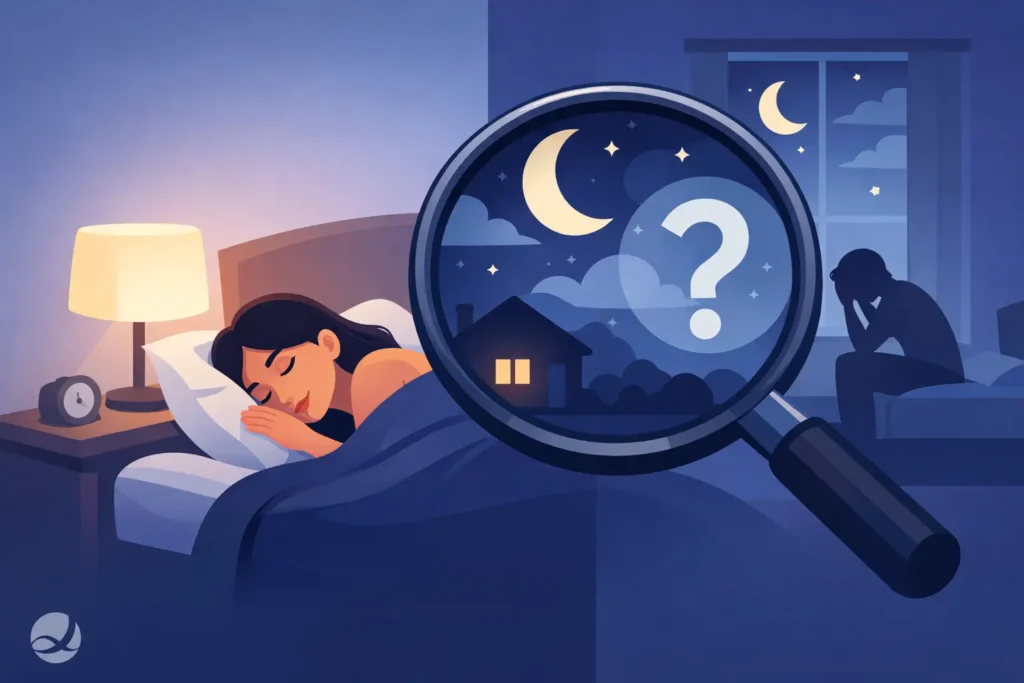
You wake at 2.17am.
Then 3.06am.
Then you look at the clock again, already doing the maths on how little sleep is left.
That is the part most people miss. Sleep therapy for night waking is not only about getting you back to sleep. It is about stopping the fear, frustration and racing thinking that turns one waking into a long, miserable night.
You are exhausted.
But your mind has other ideas.
Night waking is not always a sleep problem
Waking during the night is normal. Everybody does it. Most people simply turn over and drift off again without remembering.
The problem begins when waking becomes a pattern.
You wake and check the time. You start planning tomorrow. You worry about work, money, your health, your relationship, or the fact you are awake again. Your body picks up that message.
Something is wrong. Stay alert.
Now you are no longer just awake. You are on guard.
For some people, the waking started during a difficult period. Bereavement. A health scare. A demanding job. A relationship breakdown. A baby who would not sleep. Years later, the original situation may be over, but the pattern remains.
Your system learned to wake and scan for danger.
That does not mean you are broken. It means your mind has held on to an old rule that is no longer useful.
Why forcing sleep usually makes it worse
You cannot command sleep like you can command yourself to make a cup of tea.
The harder you push, the more alert you become.
People often tell themselves, “I have got to sleep now.” It sounds sensible. At 3am, it becomes pressure. And pressure creates anxiety.
Then comes the next layer: fear of tomorrow.
“I will be useless.”
“I cannot cope with another day like this.”
“What if this never stops?”
Those thoughts are understandable. They are also fuel for the very pattern you want to change.
This is why simply collecting more sleep tips can leave you stuck. A cooler bedroom, less alcohol and a regular bedtime can all help. But if your mind has linked the night with worry, checking and fear, better curtains alone will not change the whole thing.
What if the problem is not the waking itself?
What if it is what waking has come to mean to you?
Sleep therapy for night waking looks beyond the clock
Good sleep therapy for night waking looks at the pattern around the waking.
What happens in the minute after you open your eyes? What do you tell yourself? What feeling arrives first? Is there a familiar fear underneath it all?
The answer is different for each person.
One client may wake because their mind is still carrying the pressure of being responsible for everyone else. Another may wake with a jolt, expecting bad news. Someone else may have spent so long fighting anxiety that quiet, still moments feel uncomfortable.
The waking is real.
But it may not be the root of the problem.
My work is about finding the emotional meaning driving the pattern, then changing it. Not making you relive every detail of the past. Not keeping you talking in circles for years.
Update the past. Do not relive it.
When the old fear changes, the need to stay alert can change too. That is where real change starts.
What the work can involve
First, we get clear on what is happening now. Not what a textbook says should be happening. Your actual nights. Your actual thinking. Your actual triggers.
We look at the beliefs that keep the cycle going. Beliefs such as, “If I do not sleep, tomorrow will be a disaster,” or, “I have to stay awake in case something happens.” These beliefs can feel completely true when you are exhausted. That does not mean they need to keep running your life.
Hypnotherapy is often part of the work. There is nothing strange about it. You remain aware. You are not asleep. You are not controlled. It is a focused, calm state where we can work directly with the patterns that ordinary willpower has not shifted.
We also work with your daily habits and the way you respond when you wake. Not with a huge list of rules. With practical changes that make sense for you.
For example, clock-watching may need to go. Lying there arguing with yourself may need to stop. The habit of turning every waking into a prediction about tomorrow may need to change.
Small actions matter when they break the old pattern.
But the deeper work matters too. Otherwise, you can spend years managing symptoms while the same fear sits underneath.
A calmer response changes the whole night
When you wake, your first job is not to force sleep.
It is to reduce the alarm.
Remind yourself that waking is uncomfortable, not dangerous. Do not start negotiating with the clock. Do not begin rehearsing tomorrow’s problems in the dark.
You can use a simple phrase: “I am awake. That is all. My body knows how to sleep.”
It may sound basic. Basic is often better at 3am.
If you have been lying awake for a while and frustration is building, get out of bed. Keep the lights low. Sit somewhere quiet. Do something dull until you feel sleepy again. Do not turn it into a late-night scrolling session, a work session or a chance to solve your entire life.
The aim is to teach your mind that the bed is not a battleground.
That takes consistency. It also takes honesty. If caffeine late in the day, alcohol, irregular shifts, chronic pain or a phone beside the pillow are adding to the problem, they need addressing as well.
There is no magic sentence that cancels out habits which keep the body on alert.
When night waking needs medical attention
Not every sleep problem is emotional. This matters.
If you snore loudly, wake gasping or choking, have pauses in breathing, wake with severe headaches, feel overwhelmingly sleepy during the day, or your sleep changed suddenly without a clear reason, speak to your GP. The same applies if pain, medication, menopause, alcohol dependence or a physical health condition is involved.
Sleep apnoea and other medical issues need proper assessment.
Hypnotherapy can help with the anxiety and habits around poor sleep. It is not a replacement for medical care where medical care is needed.
That is not a weakness. It is common sense.
Stop making 3am the enemy
Night waking becomes powerful when every waking confirms a story: “Here we go again. I cannot cope. This controls me.”
That story can change.
You may still wake sometimes. Most people do. The difference is that you stop turning it into a crisis. You stop feeding it with fear. You stop spending the whole next day waiting for the next bad night.
That is control.
Clients often arrive convinced they need to learn how to live with broken sleep forever. They do not want more theory.
They want relief.
They want control.
They want to feel like themselves again.
For many people, change does not need to take years. Many clients experience real change in six hours or less, because the work is focused on the pattern, not endless discussion about it.
Based in Grimsby, I work with people across Lincolnshire and Humberside, and worldwide on Zoom.
You do not have to keep dreading bedtime.
The question is not whether you can make yourself sleep on command.
It is this: are you ready to stop managing the fear around sleep and change the pattern properly?