
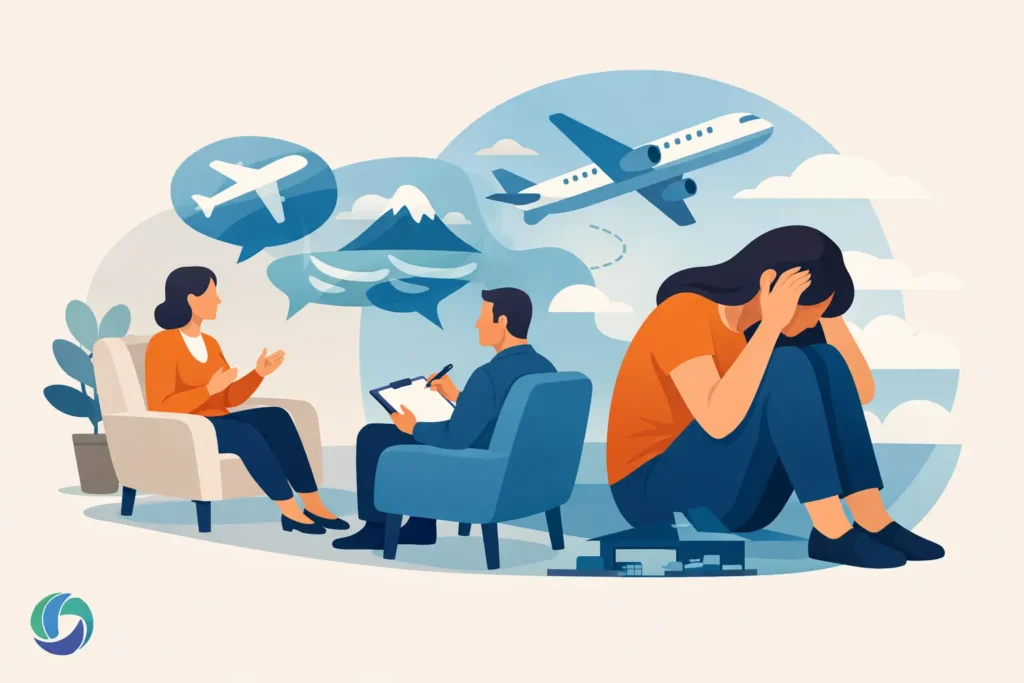
The holiday is booked.
Everyone else is counting down the days.
You are counting the ways it could go wrong.
That is where therapy for travel anxiety can make a real difference. Not by teaching you to put up with the fear. Not by giving you another breathing exercise to use while your heart is already racing.
By getting to what is actually driving it.
Because travel anxiety is rarely just about travel.
When getting away feels like a threat
For some people, it is flying.
The airport. The queues. Being shut inside a plane with no easy way out. Turbulence. The feeling that somebody else is in control.
For others, it is driving on a motorway, crossing a bridge, getting on a train, taking a ferry or being far from home. Sometimes the fear starts weeks before the trip. Sleep goes. Appetite changes. Arguments begin over things that are not really the issue.
Then comes the planning.
Checking the route. Checking the weather. Checking the hotel. Looking for the nearest hospital. Reading stories online that make you feel worse.
You may still go.
But you do not enjoy it.
Or you cancel, make an excuse, and feel relieved for a few hours. Then annoyed with yourself because anxiety has made another choice for you.
This is not weakness.
It is a pattern.
And patterns can change.
The common mistake: treating the journey as the problem
Most people focus on the obvious thing.
“I am scared of flying.”
“I cannot drive far from home.”
“I panic when I am abroad.”
Fair enough. That is what it feels like.
But what if the plane, motorway or hotel room is not the real problem? What if it is simply where the fear has attached itself?
Travel can bring up a loss of control. It can bring up fear of being trapped, being ill, making a fool of yourself, leaving people behind or not getting back home. It can also bring up an old emotional reaction that has nothing to do with the holiday itself.
Your thinking mind may know that a plane is safe.
Your body does not care.
It reacts as if there is danger now.
That is why facts alone often do not fix it. You can read every safety statistic going. You can have the most patient partner in the world. Yet the moment you see the departure board, the same feeling arrives.
You do not need more information.
You need the fear to stop making the decisions.
What therapy for travel anxiety should actually do
Good therapy for travel anxiety should not turn you into someone who loves airports or enjoys every bit of a long-haul flight.
That is not the point.
The point is choice.
Can you book the trip without days of dread?
Can you travel without needing a drink, tablets, constant reassurance or an escape plan just to get through it?
Can you feel the nerves and still remain in control?
That is real change.
The work is about finding the meaning behind the reaction and changing it. When the emotional meaning changes, the pattern changes.
You do not have to spend years going over every detail of your past. You do not need to relive it. In many cases, you need to update the past so it stops running the present.
That may sound simple.
Simple does not mean shallow.
A fear can have been with you for years. It may have started after a panic attack on a train, a difficult flight, a frightening illness, a bereavement or a time when life felt out of control. Sometimes there is no obvious starting point at all.
Either way, the reaction is learned.
And what has been learned can be changed.
Hypnotherapy is not about losing control
This matters because people often arrive with the wrong idea about hypnotherapy.
They think they will be made to cluck like a chicken, reveal secrets or lose control of what they say and do.
That is stage entertainment.
Real clinical hypnotherapy is focused work. You remain aware. You can speak. You can stop at any point. Nobody can make you do anything against your values or wishes.
The aim is not to take control away from you.
It is to help you get it back.
When anxiety takes over, it can feel as though your own mind has turned against you. The racing thoughts, tight chest and sick feeling seem to arrive without permission. But they are responses. Old protection patterns. And once you understand that, there is somewhere useful to work.
No judgement.
No pretending the fear is silly.
Just a clear process to change the response.
You do not need to wait until the next trip is ruined
People often leave this until the last minute.
The flight is in two weeks. The family are excited. The bags are half packed. Anxiety is already through the roof.
Change can still happen. But there is no prize for waiting until fear has taken over every part of the plan.
If travel has become something you endure rather than enjoy, deal with it before it becomes smaller and smaller circles around home.
Because avoidance grows.
First it is the flight abroad.
Then it is the train to see family.
Then the motorway.
Then being more than twenty minutes from home.
That is how anxiety works when it is left in charge. It persuades you that avoiding discomfort is the answer. For a moment, it feels true. Then your world gets smaller.
You do not have to accept that.
What change can look like in real life
Real change does not always look dramatic.
Sometimes it is booking a holiday without checking the cancellation policy ten times.
Sometimes it is sitting on the plane and noticing you are calm enough to read a magazine. It is driving through the Humber Bridge without pulling over. It is arriving at a hotel and getting on with your evening rather than searching for the quickest route home.
For a parent, it may mean not passing fear on to the children.
Children notice more than we think. If every journey is tense, every airport feels dangerous, every delay becomes a disaster, they learn that travel is something to fear too.
Changing your own pattern can change the atmosphere for the whole family.
That is worth thinking about.
What to do before you travel
There are practical things that help, but do not confuse them with the full answer. Being organised is useful. Arriving at the airport early is sensible. Choosing an aisle seat may make sense if feeling trapped is part of the fear.
Use practical planning to make the journey easier.
Do not use it as a ritual that convinces anxiety it is in charge.
There is a difference.
If you need to check something once, check it once. If you need to plan the route, plan it. Then stop feeding the fear with more checking, more searching and more “what if” questions.
Bring your attention back to what is real.
You are here.
You are capable.
You can handle a feeling without obeying it.
That is not positive thinking. It is a fact.
You are not broken. You are stuck in a pattern.
If you have avoided travel for years, it can become part of how you see yourself.
“I am just a nervous flyer.”
“I cannot go far.”
“That is not for people like me.”
Be careful with those statements.
They sound like facts. Often, they are simply old beliefs repeated often enough to feel true.
You are not the anxiety.
You have been living with a pattern that has become automatic. That is different. And it means there is room for change.
Based in Grimsby and working with people across Lincolnshire, Humberside and worldwide on Zoom, I see this often. People who have spent years managing. People who have missed holidays, work opportunities and time with family.
They do not want more theory.
They want relief.
They want control.
They want to feel like themselves again.
Many people experience real change in six hours or less. It depends on the person and the pattern, of course. There are no honest guarantees. But you do not need to assume this will take years.
The question is not whether you can force yourself through another trip.
The question is this: are you ready to stop managing fear and start making the choice yourself?