
Your heart is racing again.
You have checked the clock, the doors, your phone, your body, your thoughts.
You know the feeling will pass.
That does not make it any easier while it is happening.
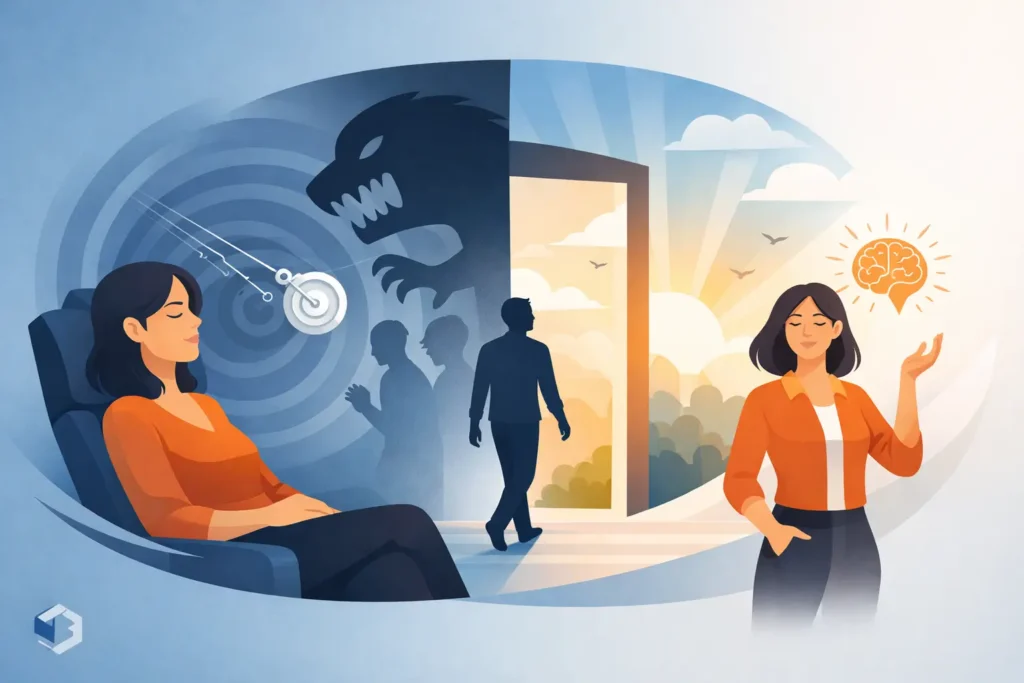
Rapid anxiety relief hypnosis is not about pretending anxiety does not exist. It is about getting to the pattern that keeps setting off the alarm, then changing what that alarm means to you.
That is where real relief begins.
Anxiety is not always the real problem
Most people come in believing the anxiety is the problem.
The racing heart.
The knots in the stomach.
The sleepless nights. The constant thinking. The need to avoid places, people or situations that once felt normal.
But anxiety is often the result of something else. A fear. A belief. An old emotional reaction that has kept doing its job long after it stopped being useful.
Your mind learned a pattern.
Perhaps it learned that being judged is dangerous. That you must stay alert. That making a mistake is not allowed. That a crowded shop, a motorway, a meeting or a phone call means something bad is about to happen.
It does not matter whether the pattern makes logical sense now. Anxiety is not logical when it has become automatic.
You can know you are fine and still feel as though you are not.
That is frustrating.
It is also changeable.
What rapid anxiety relief hypnosis actually does
Hypnosis is a focused, calm state. You remain aware. You can hear what is being said. You are not asleep, unconscious or under anyone’s control.
You are simply less caught up in the noise.
That matters because anxious thinking is noisy. It argues. It predicts. It looks for danger. It can turn one thought into twenty worst-case scenarios before you have even left the house.
In a hypnotherapy session, we slow that down. We look at what is driving the fear rather than spending months talking around the symptoms.
The aim is not to make you cope with anxiety forever.
The aim is to change the emotional meaning attached to the thing you fear.
When that meaning changes, your response can change.
A lift can become a lift again, rather than a trap.
A presentation can become a conversation, rather than a public disaster waiting to happen.
A fast heartbeat can become a physical sensation, rather than proof that something is wrong.
This is not positive thinking.
It is an update.
You are not reliving every detail of the past. You do not need to sit there and tell the same painful story over and over. We update the past, not relive it.
Can anxiety relief really happen quickly?
Sometimes, yes.
But let us be straight about what rapid means.
It does not mean a magic trick. It does not mean every person needs one meeting. And it does not mean life will never put pressure on you again.
It means change does not always need years.
Many people have spent a long time managing symptoms. Avoiding the trigger. Taking reassurance from other people. Checking. Cancelling plans. Pushing through while feeling dreadful inside.
They have become very good at surviving anxiety.
What they have not been shown is how to change the pattern beneath it.
For some people, one clear shift makes a big difference. For others, there are several layers. Anxiety around work may be tied to confidence. Panic may be tied to a fear of losing control. Social anxiety may come from years of feeling judged or not good enough.
This is why a personal approach matters.
The question is not, “How bad is your anxiety?”
The better question is, “What is your anxiety making this situation mean?”
That answer gives us somewhere useful to work.
Many clients experience real change in six hours or less. It depends on the pattern, how long it has been there and how ready you are to change it. Nobody honest can promise the same result for every person.
But quick change is far more possible than many people have been led to believe.
Why managing anxiety can keep it going
Managing anxiety has its place. You may need practical ways to get through a difficult day.
But management is not the same as freedom.
If every decision is built around avoiding a feeling, the feeling gets bigger. Your world gets smaller. The anxiety begins to make choices for you.
“No, I cannot go there.”
“No, I cannot drive that far.”
“No, I cannot speak up.”
“No, I cannot be left alone.”
At some point, it is worth asking a difficult question.
What is this pattern costing you?
Not just in lost sleep or bad days. In relationships. Work. Family time. Confidence. The ordinary things you should be able to enjoy without a running commentary of fear in your head.
You do not need to be broken to feel this way.
You may simply be running an old pattern that no longer fits your life.
And patterns can change.
What happens in a session?
The first thing is a proper conversation. Not an interrogation. Not a lecture.
We get clear on what is happening, when it happens and what you want to be different. Sometimes the person thinks they know the cause. Sometimes they do not. Either is fine.
You do not need all the answers before you start.
Then we work with the fear and the beliefs behind it in a calm, focused way. You stay in control throughout. There is no loss of control, no embarrassing performance and no one making you cluck like a chicken.
People often worry about that because stage hypnosis has given the whole thing a strange reputation.
Clinical work is different.
It is practical. Private. Focused on change.
You may leave feeling lighter. You may notice that a trigger does not hit as hard. You may find yourself doing something that previously felt impossible, then realise afterwards that you did not spend the whole time worrying about it.
That is often how change shows up.
Quietly at first.
Then clearly.
Rapid anxiety relief hypnosis is not for ignoring physical symptoms
Anxiety can produce very real physical sensations. Chest pain, breathlessness, dizziness, palpitations and nausea can all be frightening.
However, new, severe or worrying symptoms should always be checked by a medical professional. Do not assume everything is anxiety just because you have felt anxious before.
Once medical concerns have been addressed, it can be useful to look at whether fear of the sensations themselves has become part of the pattern.
A person feels their heart beat faster.
They fear the sensation.
The fear increases the adrenaline.
The adrenaline increases the sensation.
Then the cycle starts again.
Breaking that cycle is not about telling yourself to calm down. Anyone with anxiety knows that rarely works when the alarm is already blaring.
It is about changing what your mind believes the sensation means.
You do not have to keep going round in circles
You may have been told anxiety is something you simply have to live with.
Maybe you have accepted that because nothing else seemed to make a lasting difference.
But what if the problem is not the problem?
What if the issue is not that you are anxious, but that an old fear is still deciding how you respond?
Based in Grimsby, I work with people across Lincolnshire and Humberside, as well as worldwide on Zoom. The location matters less than the decision to stop managing and start living.
Real change begins when the fear of staying the same becomes stronger than the fear of changing.
You do not need more theory.
You need relief. Control. Choice.
The question is simple.
Are you ready to change the pattern?