
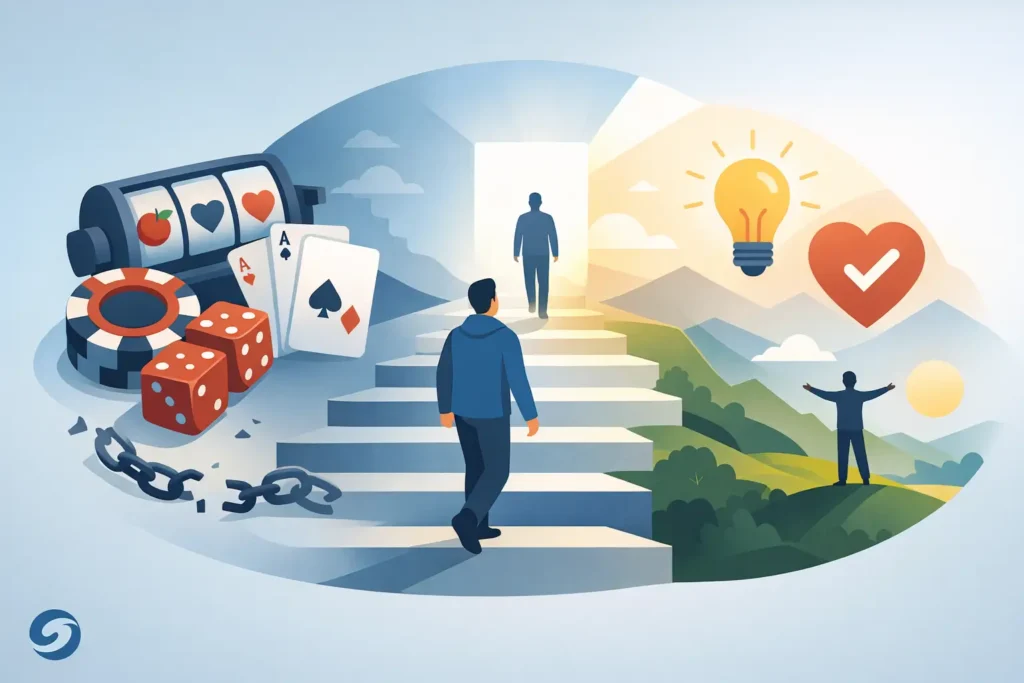
One of the hardest parts of gambling addiction is this – from the outside it can look like a money problem, but for most people it goes much deeper than that.
That is why any real guide to gambling addiction recovery has to talk about more than debt, budgets and blocking betting apps. Those things matter, but they are not the whole picture. If the pattern keeps pulling you back in, the issue is not just access to gambling. It is what gambling has come to mean in your mind, your body and your day-to-day life.
For some people, gambling gives a rush. For others, it gives escape. It can numb stress, drown out anxiety, create distraction, or offer that dangerous little whisper that one more bet will fix everything. It rarely starts as a plan to wreck your finances or your peace of mind. It usually starts as relief.
And that matters, because people are not broken. They have learned a pattern. What has been learned can be changed.
What gambling addiction recovery really means
Recovery is often spoken about as if it is simply a matter of stopping. Stop betting. Stop chasing losses. Stop lying. Stop hiding it. Of course that is part of it, but if it were that simple, most people would have done it already.
Real recovery means understanding what the gambling has been doing for you, even while it has been hurting you. That can be uncomfortable, but it is also where change begins.
If gambling has become your way to switch off, calm down, feel in control, or escape pressure, then removing it without changing the pattern underneath can leave a big gap. That is when people often white-knuckle it for a while, then end up back where they started.
A better way to look at it is this. Gambling is the behaviour. The real driver is often elsewhere.
Sometimes it is anxiety. Sometimes shame. Sometimes boredom, loneliness, grief, stress, or the need to feel something different for a few minutes. Sometimes the issue is not always the real issue.
A guide to gambling addiction recovery starts with honesty
Not public honesty. Personal honesty.
That means answering a few difficult questions without dressing them up.
When do you gamble most? What are you usually feeling just before it starts? What do you tell yourself in that moment? What are you hoping the bet will give you?
The answers are rarely just about money. You might notice that gambling shows up after arguments, after a hard day, late at night, or when you feel trapped inside your own head. You might notice that the urge arrives with a familiar thought such as, I can sort this out, I need a win, or I just need a break.
Thoughts are not facts.
That one sentence can change a lot. The mind can sound very convincing when it wants relief. It can tell you that one bet will settle things, that you are due a win, or that this time will be different. But a thought can be loud and still be wrong.
The first practical steps to break the cycle
If gambling has become difficult to control, make it harder to act on impulse. This is not glamorous, but it works.
Block access where you can. Hand over control of accounts if needed. Remove saved payment details. Limit access to money. If you live with someone you trust, be honest with them and make the situation less private. Gambling thrives in secrecy.
Some people resist these steps because they feel childish or embarrassing. Fair enough. But while you are building real control, you do not need pride getting in the way. Put barriers in place.
At the same time, pay attention to your danger times. Most addictive patterns have a rhythm. It may be evenings, payday, after drinking, after stress, or when you are alone with your phone. If you know when the pull is strongest, you can interrupt it earlier.
This does not mean filling every minute with forced positivity. It means being realistic. If Saturday afternoons are a problem, do not leave them empty and hope for the best.
Why willpower on its own usually fails
People often blame themselves because they think they should be stronger. That usually makes things worse.
Willpower is useful for short bursts. It is rubbish as a long-term plan when the pattern is tied to emotion, habit and relief. If your mind has learned that gambling is a fast way to change how you feel, it will keep offering it up, especially under pressure.
Fear plays a part as well. Not just fear of money problems or being found out, but fear of discomfort itself. The mind creates stories to keep you safe, even when those stories are nonsense. It says you cannot cope without the bet, you need one release, one chance, one comeback. Fear is often an illusion, a story the mind creates to keep us safe.
The trouble is, what feels safe in the moment can be destructive over time.
What to do when the urge hits
An urge feels urgent, but it is not permanent. That is worth remembering because in the moment it can feel like the only thing that matters.
When the urge arrives, slow the moment down. Name what is happening. Say it plainly. I feel the pull to gamble. I feel stressed. I want escape. That small pause matters because it separates you from the automatic reaction.
Then change the scene. Get up. Leave the room. Hand your phone over. Go outside. Ring someone. Delay the action by ten minutes, then ten more. You are not arguing with the urge. You are outlasting the wave.
This is not magic. Some days it will feel clumsy and frustrating. But every time you interrupt the pattern, you teach your mind something new.
Dealing with shame without getting stuck in it
Shame keeps a lot of gambling addiction alive.
It tells people they are weak, stupid, selfish or beyond help. It keeps them hiding losses, covering tracks and pretending things are fine. It also makes it harder to ask for help because shame loves silence.
But shame is not a recovery plan. It is just more pain piled onto pain.
Take responsibility, yes. Absolutely. If gambling has damaged trust, money or relationships, that needs facing. But beating yourself up is not the same as changing. One keeps you trapped. The other moves things forward.
You may need to repair practical damage slowly. That can mean honesty about debt, tighter financial boundaries, and difficult conversations. None of that is easy. But difficult is still better than staying stuck.
Why the right help can make recovery faster
If you have been battling this alone for a while, there is a good chance you are exhausted. Not because you do not care, but because fighting the same pattern over and over wears people down.
This is where good help matters. Not endless theory. Not being analysed to death. Real help should get to the root of what is driving the behaviour and help change that pattern.
For some people, gambling addiction sits on top of anxiety that never really switches off. For others, it is linked to old stress, pressure, trauma, or a deep need to escape how they feel. When that underlying pattern changes, the pull towards gambling can change too.
That is often why people feel stuck after using only surface-level tools. They have spent years fighting the behaviour, while the engine underneath keeps running.
At Grimsby Hypnotherapy, that is a big part of the work. The focus is not on labelling people or making them relive every painful detail. It is about understanding what is keeping the pattern switched on, then changing it properly.
Guide to gambling addiction recovery for families
If you are reading this because someone you love is gambling, you are probably angry, frightened and tired of excuses. That is understandable.
You cannot force somebody to change before they are ready. But you also do not have to make it easy for the pattern to continue.
Clear boundaries matter. Honesty matters. So does refusing to fund the problem or cover it up. Families often get pulled into crisis management and end up carrying the weight of somebody else’s choices. That helps nobody in the long run.
If your role has become policing, rescuing and constantly checking, you will be worn out too. You need clarity as much as they do.
What recovery can actually look like
Recovery is not always a big dramatic moment where everything suddenly clicks into place. Sometimes it starts with one honest conversation, one blocked account, one evening handled differently, one decision not to chase a loss.
Then it builds.
You begin to notice the urge sooner. You stop believing every thought your mind throws at you. The panic eases. You feel less pulled around by impulse. You start to trust yourself again.
That does not mean every day is perfect. It means the pattern is losing its grip.
If you are stuck in this right now, remember this. Gambling addiction is not proof that you are weak or broken. It is a learned response that has been repeated often enough to feel automatic. Automatic does not mean permanent.
You do not need more guilt. You need a clear way forward, and a real decision to stop feeding the thing that is draining your life. That decision may feel uncomfortable at first. Good. Most real change does.
But uncomfortable is still better than another month, another year, of going round the same miserable loop.
The sooner you deal with what is driving the pattern, the sooner you can start feeling like yourself again.