
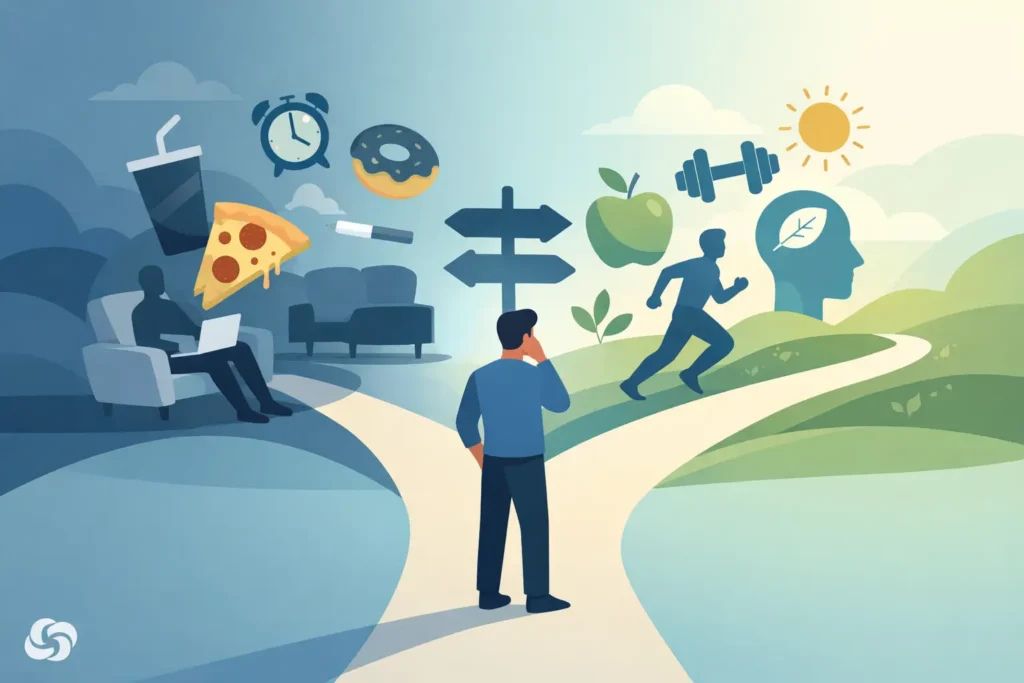
You do not wake up one morning and decide to ruin your own life. Most unhealthy habits start as a solution. A cigarette settles your nerves. A drink takes the edge off. Scrolling helps you switch off. Avoiding something gives you short term relief. Then the thing that helped starts costing you more than it gives.
That is why any proper guide to changing unhealthy habits has to start in the right place. Not with blame. Not with willpower. Not with another promise to be better from Monday. It starts with understanding why your mind keeps pulling you back towards the same behaviour, even when part of you is sick of it.
The real problem is not lack of discipline
Most people I speak to have already tried to stop. More than once. They have used apps, routines, reward charts, self-help books and stern talks with themselves in the mirror. For a few days, sometimes even a few weeks, they manage it. Then stress hits, sleep drops, emotions build, or life gets messy, and the old pattern comes back.
This is the point where people often decide there must be something wrong with them. They call themselves lazy, weak, broken or hopeless. That is usually miles away from the truth.
Unhealthy habits are often wired in because they serve a purpose at an unconscious level. They reduce tension. They create numbness. They offer escape. They give a sense of control. If your mind believes a habit helps you cope, it will keep pushing you towards it, even when the logical part of you hates it.
So if you have been trying to change a deeply ingrained pattern by arguing with yourself, forcing yourself, or shaming yourself, it makes sense that progress has been patchy. You have been trying to beat a pattern without dealing with what is driving it.
Why unhealthy habits stick
A good guide to changing unhealthy habits needs to be honest about this. Habits do not stick because you enjoy suffering. They stick because your system has learned that the behaviour does something useful.
Sometimes the payoff is obvious. Drinking may shut off anxious thoughts for a while. Gambling may create excitement when life feels flat. Comfort eating may bring relief after a hard day. Nail biting may discharge tension. Avoidance may protect you from embarrassment or fear.
Sometimes the payoff is less obvious. A habit can become part of how you see yourself. If you have lived for years as the person who panics, the person who overeats, the person who sabotages things, or the person who always gives in, the behaviour starts to feel familiar. Familiar is powerful. The mind often chooses what is familiar over what is healthy.
There is also the issue of state. When you are calm and clear-headed, change feels possible. When you are overwhelmed, triggered or exhausted, your brain wants speed and certainty. It reaches for the old route because it knows it well. That is why people can feel completely committed to change at 9 am and back in the habit by 9 pm.
None of this means you are trapped. It means the pattern makes sense. And when something makes sense, it can be changed properly.
Stop treating the habit as the enemy
This is where many people get stuck. They focus all their energy on the visible behaviour and ignore the machinery behind it.
If you only attack the habit, you tend to create an internal fight. One part of you wants change. Another part still believes the habit is protection, comfort or relief. That conflict drains people. It is exhausting trying to white-knuckle your way through a battle inside your own head.
A better approach is to ask a more useful question. What is this habit doing for me right now?
That question is not an excuse. It is a shortcut to the truth. Once you know what the habit is trying to achieve, you can deal with the real issue rather than chasing symptoms.
For one person, smoking may be tied to nervous system regulation. For another, it is identity and routine. For someone else, it is rebellion, comfort, or a break from pressure. The same outward habit can be driven by very different inner patterns. That is why generic advice often falls flat.
The reframe that changes everything
You do not need more self-punishment. You need a better map.
If a habit has become automatic, it is not because you consciously chose it every time. It is because your mind learned a shortcut and repeated it until it became the default. That means change is less about being tougher and more about updating the pattern.
This matters because it takes the problem out of the moral category. You are not trying to become a good person instead of a bad one. You are changing a learned response that no longer serves you.
That shift brings relief. It also brings responsibility. Once you understand that the pattern can be updated, you stop waiting for motivation, the perfect week, or some dramatic turning point. You start dealing with the habit where it actually lives, which is below the level of simple logic.
How to change unhealthy habits in a way that lasts
The first step is to get specific. Vague goals create vague results. Saying, I need to sort myself out, is not a plan. Saying, every evening after work I feel tense, then I eat, drink, scroll or avoid to shut off, gives you something real to work with.
Pay attention to the sequence. What happens just before the habit starts? What feeling shows up? What thought appears? What situation tends to trigger it? The habit itself is only one part of the chain.
The second step is to identify the payoff. Be honest here. What does the habit give you in the moment? Relief, distraction, numbness, comfort, certainty, control, stimulation, escape? If you do not identify the payoff, you will keep trying to remove the behaviour without replacing the function.
The third step is to address the driver, not just the surface. If anxiety is driving the habit, then calming the system matters. If old emotional learning is driving it, that needs updating. If the habit is linked to trauma, fear, shame or an old identity, then that root pattern has to change. Otherwise you are asking yourself to give up your coping strategy while leaving the original pressure intact.
This is why some people make fast progress when they work at the unconscious level. When the mind no longer sees the habit as necessary, the struggle often drops away. You are not constantly resisting yourself. The pull weakens because the reason for the pull has changed.
The fourth step is to make the new response easy to repeat. If your replacement strategy is complicated, slow or unrealistic, it will not survive a bad day. The new response needs to work in real life. It needs to fit around work, family, tiredness and stress.
And finally, expect some discomfort. Not because change has to be miserable, but because your system is learning something new. There can be a wobble between the old pattern losing strength and the new one feeling natural. That does not mean the process is failing. It usually means it is underway.
Where people go wrong
People often wait until they feel ready. That sounds sensible, but it can be a trap. Readiness rarely arrives as a perfect feeling. More often, change begins when you are fed up enough to stop negotiating with the problem.
Another mistake is trying to change ten things at once. When people feel frustrated with themselves, they often launch a full life overhaul. New routine, new diet, no drinking, no scrolling, early mornings, gym every day. It looks strong for 48 hours and then collapses. Not because they cannot change, but because they have created too much internal friction.
The other big mistake is believing that understanding the habit is the same as changing it. Insight helps, but insight alone does not rewire a pattern. Plenty of people know exactly why they do what they do and still keep doing it.
Real change is simpler than people think
You do not need to spend years analysing every bad habit you have ever had. You do not need endless coping strategies. You do not need to keep managing the same pattern forever.
What you do need is the right target. If you go after the root of the habit, change can happen far more quickly than people expect. That is true whether the pattern shows up as anxiety behaviours, addiction, smoking, compulsions, avoidance, emotional eating, or any other response that has got stuck on repeat.
I have seen plenty of people come in feeling defeated because they have tried before and failed before. What changes things is not more pressure. It is finally working on the part of the problem that actually runs the show.
If you are tired of promising yourself you will stop, only to end up back in the same place, take that seriously. Not as proof that you cannot change, but as proof that this needs a different approach.
You are not meant to spend your life fighting with your own mind. The goal is not to become better at coping with a habit you hate. The goal is to become free of the pattern so your choices feel like your own again.
Ready to experience real change or keep repeating the same pattern? Book your Real Change Meeting here https://Derekmindcoach.as.me/