
The meeting is at 10am.
Your heart starts thumping at 7am.
By 9am, you have already imagined getting your words wrong, going red, being judged, looking stupid and wanting to leave.
Then someone says, “Just be confident.”
If only it worked like that.
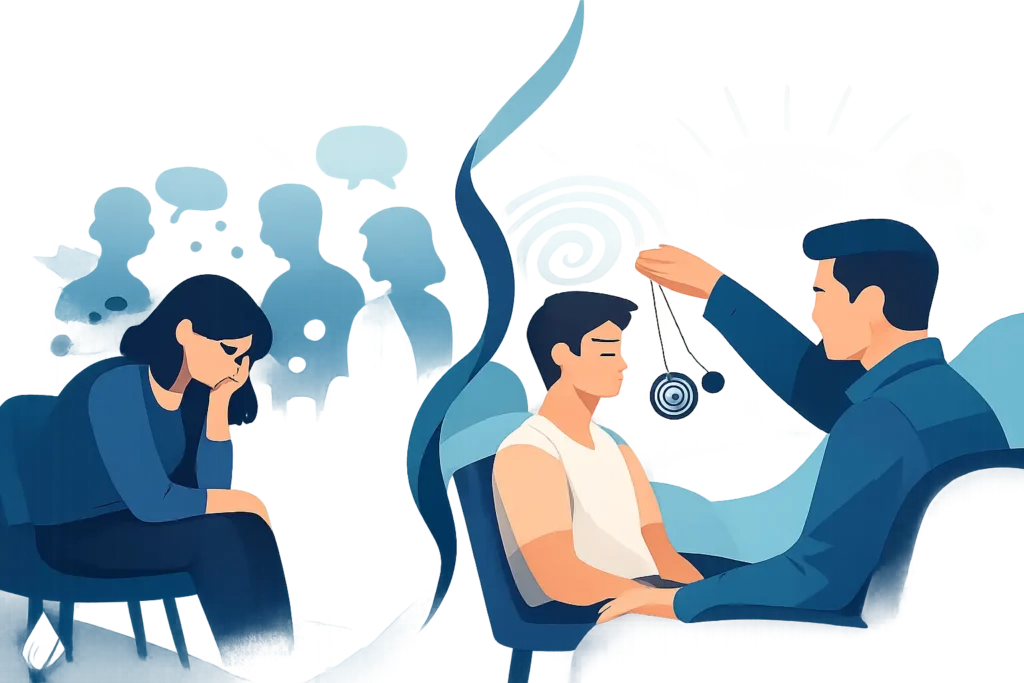
So, can hypnosis help social anxiety?
Yes, it can. But not by turning you into the loudest person in the room. And not by making you into somebody you are not.
Good clinical hypnotherapy looks at the fear pattern driving the anxiety. Then it helps you change the meaning your mind has attached to certain people, places and situations.
That is where real change begins.
Can hypnosis help social anxiety when nothing else has?
Social anxiety is not simply shyness.
It is the fear of being seen. The fear of being judged. The fear that people will notice something is wrong with you.
For some people, it means avoiding parties, meetings or speaking up at work. For others, it is making phone calls, eating in public, dating, going to the gym or even walking into a shop.
You might look calm on the outside.
Inside, you are monitoring everything.
Your voice. Your face. Your hands. What you said five minutes ago. What they might be thinking now.
It is exhausting.
The common belief is that you need to force yourself through it, again and again, until it gets easier. Sometimes gradual action does help. But if the emotional fear underneath stays the same, you can keep putting yourself through situations while still feeling awful.
That is not freedom.
That is managing.
Hypnosis can help social anxiety because it works with the automatic emotional response, not just the surface behaviour. It gives us a way of looking at why a normal social situation has become coded as a threat.
What if the problem is not the room full of people?
What if the problem is what your mind believes that room full of people means?
Social anxiety is a pattern, not your personality
Many people with social anxiety have started to describe themselves in one fixed way.
“I am awkward.”
“I have no confidence.”
“I cannot cope with people.”
“I have always been like this.”
But a pattern is not a personality.
You were not born fearing a conversation in the office kitchen. You learned, somewhere along the line, that being noticed could bring embarrassment, rejection, criticism or humiliation.
Maybe there was one moment that sticks in your mind.
Maybe there were years of feeling different, picked on or put down.
Maybe nothing dramatic happened at all. You simply became very good at expecting the worst from yourself.
The details matter, but you do not need to sit and relive every difficult moment to change. The aim is to update the past, not relive it.
When the emotional meaning changes, the pattern changes.
What hypnosis actually feels like
A lot of people worry that hypnosis means losing control.
It does not.
You are not asleep. You are not unconscious. You cannot be made to say things you do not want to say, or do things you do not want to do.
Hypnosis is a focused, relaxed state. Most people say it feels familiar. Like being deeply absorbed in a film, a book or a long drive, while still knowing where you are.
You can hear what is being said. You can speak. You can stop at any point.
The difference is that the usual noise starts to settle. That gives us room to work with the thinking, beliefs and emotional reactions that keep social anxiety in place.
This is not about positive thinking.
Telling yourself you are confident when every part of you feels under threat can feel ridiculous. Your mind will simply argue back.
Instead, we look for what is really driving the fear. The need to get every word right. The belief that mistakes are dangerous. The old feeling that you are not good enough. The habit of scanning everyone else for signs of disapproval.
Then we change the pattern at its source.
The change is practical, not performative
The goal is not to make you perform confidence.
The goal is for you to feel less threatened by ordinary life.
That could mean walking into a room without rehearsing what to say. Speaking in a meeting without your face burning. Going for a coffee without checking whether everyone is looking at you. Saying no without days of guilt afterwards.
Small things to other people.
Massive things when anxiety has been running your life.
In a session, I will ask direct questions. Not to catch you out. To get clear on the pattern.
What happens just before the anxiety hits?
What do you tell yourself in that moment?
What are you frightened people will think?
And what would change if that fear was no longer in control?
From there, the work is personal. No two people have exactly the same reason for social anxiety, even when the symptoms look similar.
One person may fear being laughed at after years of criticism. Another may fear attention because they were made to feel ashamed. Someone else may have become stuck after one bad presentation or panic episode.
Same label.
Different pattern.
That is why generic advice often falls flat.
It is not magic, and it is not a guarantee
Anyone telling you hypnosis works for everyone, every time, is not being straight with you.
It depends on the pattern, how long it has been there and whether you are ready to change it. It also depends on whether you are willing to make different choices once the fear begins to ease.
Hypnosis is not something done to you while you stay exactly the same.
It is a process you take part in.
You still have to answer the call. Walk into the room. Have the conversation. But you can do those things without the same internal fight.
Many clients feel real change in six hours or less. Some need fewer meetings. Some need more. There is no prize for rushing, and no benefit in dragging it out.
The point is change you can actually feel.
If social anxiety is severe, or sits alongside depression, panic, alcohol dependence or thoughts of harming yourself, speak to your GP or an appropriate medical professional as well. Getting the right help is not weakness. It is taking control.
You do not have to become extroverted
This matters.
There is nothing wrong with being quiet. Nothing wrong with preferring a small group to a crowded pub. Nothing wrong with needing time alone.
The issue is not your temperament.
The issue is fear making your choices for you.
Do you stay quiet because you have nothing to say, or because you are terrified of saying the wrong thing?
Do you avoid the event because you genuinely do not want to go, or because anxiety has already decided you cannot cope?
That is the difference between choice and control.
The aim is not to turn you into an extrovert. It is to give you freedom. Freedom to speak when you want to. Go when you want to. Say no when you want to. Be yourself without constantly checking whether you are acceptable.
Whether you meet me in Grimsby or work with me on Zoom, the focus stays the same.
Stop managing the pattern.
Start changing it.
You are not broken. You have learned a fear response that no longer works for you.
And learned patterns can change.
The real question is not whether social anxiety has been with you for years.
The real question is whether you are ready to stop letting it choose your life.