
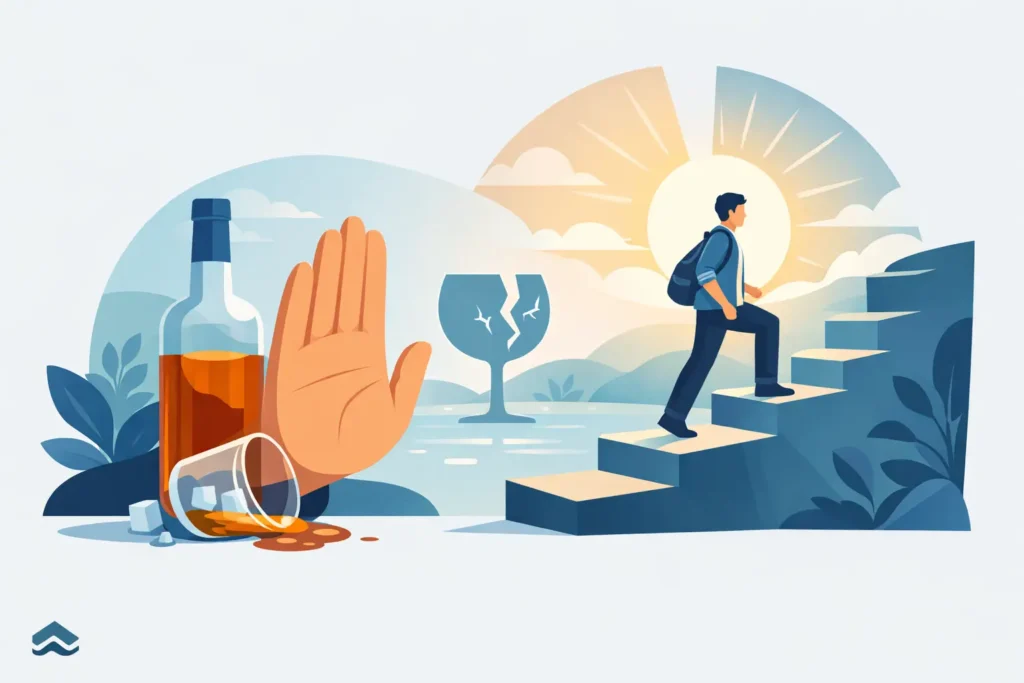
When alcohol has become the thing that gets you through the day, switching it off is not simply a matter of willpower.
This guide to stopping alcohol dependence is about making a clear, safe decision. Not beating yourself up. Not pretending it is fine because you still get to work, pay the bills or keep a smile on your face.
You may be functioning.
But inside, you know who is in control.
Alcohol dependence can creep up quietly. A drink to relax becomes a drink to sleep. Then a drink to settle the shakes, stop the anxiety, face people, numb anger or get through another ordinary Tuesday.
That is not weakness.
It is a pattern.
And patterns can change.
First, be honest about what is happening
Most people spend a long time negotiating with themselves before they admit alcohol has become a problem.
‘I only drink wine.’
‘I never drink in the morning.’
‘I can stop for a few days.’
‘I have had a stressful time.’
Some of those things may be true. But they do not answer the real question: is drinking taking more from your life than it gives?
Look at what happens when you do not drink. Do you become shaky, sweaty, anxious, sick, restless or unable to sleep? Do you plan your day around alcohol? Hide how much you drink? Make promises in the morning, then break them by teatime?
That is a sign this has moved beyond a habit.
It may be dependence.
You do not need to label yourself for life. You do need to face the facts. Real change starts there.
Stopping alcohol dependence safely comes before everything else
This is the part people can get badly wrong.
If you drink heavily every day, or you have had withdrawal symptoms before, suddenly stopping alcohol can be dangerous. In some cases, it can be life-threatening.
Do not make a dramatic decision at midnight and go it alone the next morning.
Speak to your GP, an alcohol service or a medical professional before cutting down or stopping if you are physically dependent. They can assess the level of risk and decide whether you need medically managed withdrawal.
Get urgent medical help or call 999 if you have seizures, hallucinations, severe confusion, chest pain, collapse, severe vomiting, or feel at immediate risk of harming yourself or somebody else.
This is not being dramatic.
It is being sensible.
Alcohol changes the way your body works when it has been there for a long time. Getting physically stable gives you a proper chance to deal with what comes next.
A guide to stopping alcohol dependence is not just about removing drink
Here is the bit many people miss.
Alcohol is rarely the whole problem. It is often the answer you found to another problem.
Anxiety.
Pressure.
Anger.
Loneliness.
A need to switch your head off.
A fear of not being enough.
For a while, alcohol appears to work. It gives relief quickly. That is why the pattern becomes so strong.
Then the price goes up.
Your sleep gets worse. Your anxiety increases. Your confidence drops. Relationships become harder. You make choices you would not make sober, then drink to escape how you feel about them.
Round and round you go.
What if the problem is not that you love alcohol?
What if alcohol has become your quickest way of escaping feelings you do not know how to handle any other way?
That is where the real work begins.
Change the pattern, not just the drink
You can remove alcohol from the house. You can avoid the pub. You can tell yourself you will never drink again.
Those things can help.
But if the same fear, pressure or old emotional reaction is still running underneath, you can be left fighting yourself every day.
That is exhausting.
The aim is not to spend the rest of your life white-knuckling it. The aim is to reach a point where alcohol stops feeling like the answer.
That means looking at the trigger honestly.
Maybe you drink after arguments because conflict makes you feel small.
Maybe you drink alone because silence brings up things you would rather not think about.
Maybe you drink after work because you have spent all day acting confident while feeling anxious underneath.
The drink is the behaviour. The emotional meaning behind it is often what keeps it alive.
When that meaning changes, the pattern can change.
You do not need years spent reliving every detail of the past. You can update the past, not relive it. You can understand why a pattern began without allowing it to decide what happens next.
Make the next few weeks easier, not harder
Early change is not the time to prove how tough you are. It is the time to make sensible choices.
Tell one or two people who will be straight with you. Not people who will shame you. Not people who will make it about themselves. People who understand that you are ready to change.
Remove alcohol from your immediate environment where you can. If your kitchen is full of it, your decision has to be made again every time you open a cupboard. That is unnecessary pressure.
Plan the dangerous times. For many people, it is not all day. It is 5pm. Friday night. After a row. The drive home. The moment everyone else has gone to bed.
Do not leave those moments blank.
Eat properly. Drink water. Get to bed at a reasonable time. Go for a walk even when you cannot be bothered. These are not clever tricks. They are basic ways of making your body and thinking less vulnerable.
And be careful with the idea that one drink will not matter.
For somebody without dependence, one drink may be one drink. For somebody caught in the pattern, it can be the opening of a familiar door. It depends on the person, but honesty matters more than bargains.
Expect discomfort, but do not confuse it with failure
There will be uncomfortable moments.
You may feel flat. Irritable. Restless. You may miss the routine, the release, even the person you believed you became after a few drinks.
That does not mean you have made the wrong choice.
It means you are no longer using alcohol to cover everything up.
A craving is not an instruction. It is a feeling. It rises, it peaks and it passes.
The thought ‘I need a drink’ is often not the truth. It is an old pattern asking to be repeated.
Pause.
Ask a better question: ‘What is actually going on with me right now?’
Sometimes the answer is hunger or exhaustion. Sometimes it is anxiety. Sometimes it is anger you have swallowed all day. Sometimes it is a difficult memory showing up in disguise.
Name it clearly. Then make a choice that moves you towards control, not away from it.
When you need more than determination
Determination gets praised a lot. It has its place.
But determination alone can fail when drinking is tied to anxiety, fear, old experiences or deeply ingrained beliefs about yourself.
You may know exactly what alcohol is doing to your life and still feel pulled towards it. That does not mean you are broken. It means information is not enough.
This is where focused work can make a real difference. Not endless talking. Not managing the same issue for years. Looking at what drives the pattern and changing the emotional response attached to it.
At Grimsby Hypnotherapy, the work is direct and personal. It is about helping you regain control, reduce the pull of old patterns and build emotional freedom. Many people find real change in six hours or less, although nobody honest can promise the same result for every person.
Your physical safety always comes first. Any work around alcohol dependence should sit alongside proper medical advice where withdrawal is a risk.
You can be based in Grimsby, Cleethorpes, Louth, Barton or further afield or worldwide over Zoom. The postcode is not the point.
The point is this.
You do not have to keep waking up, making the same promise, then watching the same pattern take over by evening.
There comes a moment when the fear of staying the same becomes stronger than the fear of changing.
If that moment is now, make the next choice a clear one.