
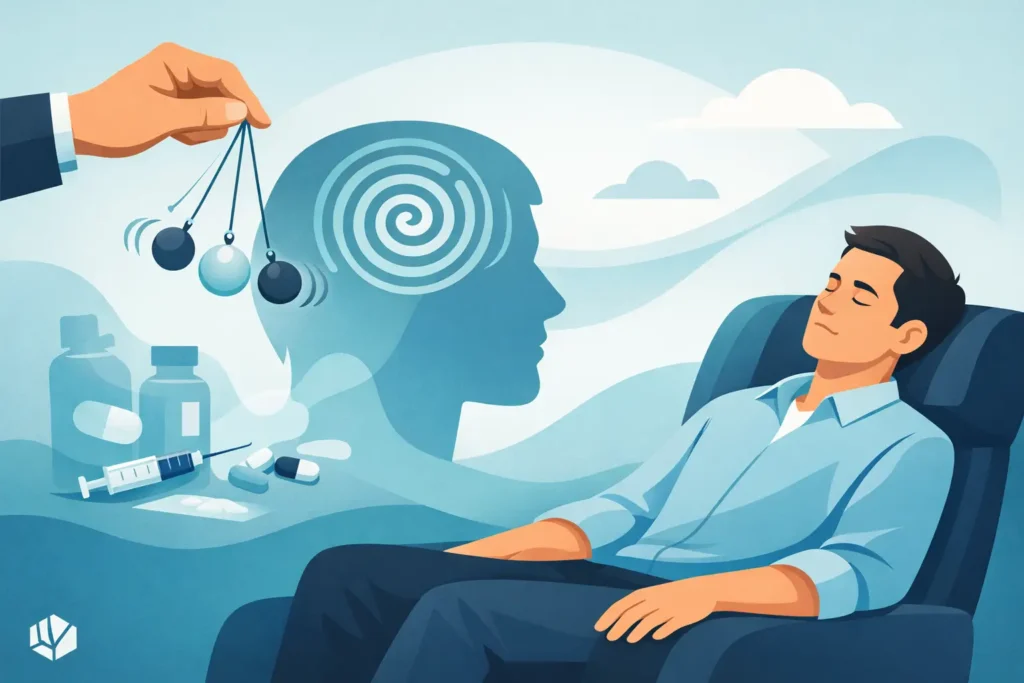
If you are asking whether drug addiction hypnosis help is real, you are probably past the point of wanting another leaflet, another lecture, or another person telling you to just be stronger. When a pattern keeps pulling you back in, willpower on its own often is not enough. That does not mean you are weak. It usually means something deeper is driving the behaviour.
That is the part many people miss.
Addiction is rarely just about the drug. The drug is often the quickest way the mind has found to change how you feel. It may numb pain, switch off stress, block guilt, quiet fear, or create a break from thoughts that feel relentless. So if you only focus on stopping the drug, without changing the pattern underneath it, the struggle can keep coming back in a different form.
Can drug addiction hypnosis help in a real way?
Yes, it can help, but only when it is used honestly and properly.
Hypnosis is not magic. It is not mind control. It is not someone waving a watch and making you do things against your will. It is a focused way of working with the patterns that keep certain thoughts, feelings and behaviours running automatically.
That matters with addiction because addiction often becomes automatic. A trigger happens, a feeling rises, the urge kicks in, and before you have properly caught up with yourself, the behaviour is already in motion. People often describe it as if something takes over. In reality, a learned pattern is taking over.
People are not broken. They have learned a pattern. What has been learned can be changed.
Hypnotherapy may help by reducing the pull of triggers, changing the emotional meaning attached to using, and helping you respond differently when the old urge appears. It can also help with the thoughts that often keep addiction going, such as shame, panic, hopelessness, and the belief that this is just who you are now.
Thoughts are not facts. That one sentence can matter a lot in addiction work.
Why the issue is not always the real issue
A person might say, “My problem is cocaine” or “My problem is painkillers” or “My problem is cannabis.” Fair enough. But very often that is only the visible part.
The real problem may be anxiety that never switches off. It may be old hurt. It may be pressure. It may be a constant inner battle between feeling too much and wanting to feel nothing at all. It may be a deep habit of escape.
This is why some people stop one substance and slide into another behaviour. The surface changes, but the engine underneath stays the same.
Fear often works like that too. The mind creates a story to keep you safe, but the story becomes the trap. Use this. You will cope. Avoid that feeling. Do not face what is underneath. For a while, it can seem like the drug is helping. Then the pattern starts taking more than it gives.
Good hypnotherapy looks at what is actually driving the behaviour, not just the behaviour itself.
What hypnosis can and cannot do
It is worth being straight about this.
Hypnosis can help interrupt habits, reduce cravings, build more control, and change how you respond to stress and triggers. It can help someone feel calmer, clearer, and less pulled towards self-destructive behaviour. It may also help shift the emotional weight that sits underneath the addiction.
What it cannot do is act as a miracle cure while someone carries on living in the exact same way with no honesty, no willingness, and no action. Anyone who tells you one session will wipe away every urge forever is overselling it.
It also is not a replacement for medical care when that is needed. Some drug dependencies involve withdrawal risks that should be handled medically. That is not scare talk. It is just common sense. Safety comes first.
So the honest answer is this. Hypnosis can be powerful help, but it works best as part of a clear change process. It is not about being rescued. It is about helping you take back control.
How drug addiction hypnosis help is usually felt
Most people do not walk out saying, “Well, that was dramatic.” It is often more practical than that.
They may notice that the old trigger does not hit with the same force. They may feel a gap between urge and action where there used to be none. They may start thinking more clearly in situations that usually led to using. They may stop feeling as if every craving is an emergency.
That gap matters. A lot.
When you have space to think, you have space to choose. And when that happens often enough, the old pattern starts losing power.
Some people also feel relief because they finally understand that the addiction is not proof they are damaged beyond repair. It is a pattern that made sense at some point, even if it is now wrecking things. Once that clicks, change tends to feel more possible and less like a punishment.
Why people stay stuck for so long
It is not always because they do not want to stop.
Some stay stuck because they are ashamed and have started believing their own worst thoughts. Some are exhausted from fighting themselves. Some have already spoken to professionals and still feel like nobody has got to the real issue. Others have stopped before, maybe more than once, and every setback has chipped away at their confidence.
That is where a different approach can matter.
If you have spent years being told what to do, but nobody has helped you change the pattern driving it, you can end up feeling as if change is for other people. It is not. But the method has to fit the problem.
Anxiety is a good example. It can be like a warning light on a car dashboard. The warning light is not always the real problem. The pattern keeping it switched on needs to change. Addiction often works in a similar way. The behaviour is visible, but it is not always the real fault line.
Who may benefit most from this approach
Hypnotherapy can be especially useful for people who know they are caught in a loop and are fed up with talking around it without changing it. It can suit people who want a practical, direct way of working and who are ready to be honest about what the drug has been doing for them, not just what it has been doing to them.
It can also help people who feel frightened by their own thoughts. Many worry that urges mean they secretly want to fail. Not necessarily. Often the mind is just running an old programme at speed. Once you understand that, the urge can feel less personal and less powerful.
That said, timing matters. If someone is being pushed into getting help and does not actually want to engage, the work is harder. Not impossible, but harder. Real change usually starts when the person is ready to stop arguing for the pattern that is hurting them.
What a good therapist should be looking for
A good practitioner will not just ask what drug you are using and how often. They should also want to understand what happens before the urge, what role the drug plays, what emotional states trigger it, and what the pattern is protecting you from.
That does not mean endless digging through your past.
Sometimes you do not need to go over every detail of what happened years ago. You need to change what is happening now in the way your mind responds. For many people, that is a relief.
If you are looking at drug addiction hypnosis help, look for someone who is clear, grounded, and realistic. Someone who does not dramatise the process. Someone who can explain things simply. Someone who sees you as a person, not a label.
A more useful question than “Will it work?”
The better question is often, “What is this pattern doing for me, and what needs to change so I no longer need it?”
That question gets closer to the truth.
Because if a drug has become your fast exit from pressure, fear, pain, emptiness, anger, or self punishment, then recovery is not just about stopping. It is about removing the need for that escape to feel so compelling.
This is where good hypnotherapy can be genuinely useful. It helps calm the internal fight, loosen old associations, and build a different response where there used to be an automatic one. Not by force. By change at the level where the pattern has been running.
If that sounds more practical than inspirational, good. Practical change is what most people actually need.
If you are stuck in addiction, or watching someone you love go round the same circle again and again, do not assume this is just how life will be now. Patterns can feel permanent right up until the point they begin to change.